 A Golden Rule Company
How to Do Less in Your Job Search (and Get Better Results)
Last Updated on January 4, 2026 by Jessica Hernandez
The invisible race to apply to X number of jobs on LinkedIn per day, the pressure to do ‘all the things’ to move your job search forward, and the nonstop stream of advice online from well-meaning influencers will run you ragged.
Then there’s the exhaustion from spending hours tailoring a resume for it not to get read (or to be automatically rejected). Job seekers are feeling overwhelmed, pulled in all directions, and frustrated. The “hustle” approach of volume over connection does not work. It leaves you feeling drained, desperate, and defeated.
We weren’t built to live in a constant loop of “Search, Apply, Rejection, Repeat.”
What if the goal isn’t more? What if it’s making a better investment with our time and energy, so we protect our souls and minds while walking through the fire? Because job searching is definitely a trial by fire. What if the goal isn’t more applications, but more connections?
Let’s walk through exactly how to do less in your job search and get better results because of it.
Why Applying Less Can Lead to More Offers
It may seem counterintuitive, but give me a second to explain; this might provide the stress relief you’ve been desperately needing. I am a numbers nerd. I could’ve been a researcher in another life. I love digging into the data that much.
Before I suggest a strategy or use it with my clients, I want to see the data supporting it and why it works. Well, there’s a plethora of data out there on the rock bottom conversion rate of online applications to interviews.
According to AshbyHQ, only 6% of total hires came from online applications on major job boards like LinkedIn and Indeed last year.
Now, before you click out of this article, hear me out. There is a place for online applications – but it’s applications coming from a place of strategy and intention, not volume, false productivity, or panic.
There are also some interesting numbers from multiple places that show the most successful job seekers (those who land their next role in less than 6 months) apply to fewer jobs, not more. I’ll share two here: the Devry Career Study and the Huntr Job Search Trends Report for 2025, both of which show that the most successful job seekers apply to only between 10-20 jobs.
Job seekers who land faster apply to fewer jobs.
Job hunting is not a numbers game. It’s not about how many applications you can throw out into the ether. You’ve been lied to. That volume-based, ‘more is better’ tactic is diluting the quality of your options and taking precious time away from activities with a higher effort-to-interview conversion rate. When you’re everywhere, you make progress nowhere.
If you’re applying to 80+ jobs per week, then you don’t have the time to make connections at specific companies, build relationships, follow up with contacts, or reach out to hiring managers after you apply.
When you pull back and focus, your applications become sharper, your networking becomes authentic, and your results (interviews) actually increase.
During my husband’s last job search, one application alone took him 2 hours to complete. That was a considerable time investment and very stressful. If you’re spending 2 hours per application, the submission part alone becomes a full-time job, and there’s no time or energy left for high-yield activities – the ones with a 40-60% success rate getting interviews.
I’m not saying don’t apply online. Hear me on this, there is a place for an online application. My husband invested the time because it was for a role at his #1 target company. But we did not leave that application to chance (or the ATS). Instead of spending time submitting more applications elsewhere, he invested his time in high-ROI activities to get his foot in the door at his target company. Ultimately, he got an interview on day 7 of his job search, an offer on day 12, and he started his new job at his target company on what would’ve been day 19.
Related: Why Traditional Job Searches Fail (And What to Do Instead)
How to move from a scattered approach to high-ROI activities
To be clear, I’m not suggesting you stop applying cold turkey without a plan. It’s not about doing nothing; it’s about doing the right things. You might not apply every single day, but every time you do engage with your search, it’s high-leverage (e.g., a coffee chat, a targeted application, a follow-up). Techniques with a high interview conversion rate surround your application. You’re productive in your search in a way that brings peace and not panic.
Have you noticed that spending too much time on LinkedIn affects how you feel? You see others announcing roles and wonder why you’re not. Or, you see someone share a very personal post about their struggles with joblessness and inability to get interviews? You apply to roles and hear nothing back or get an instant automated rejection, and it chips away a little more at your confidence and peace. It weighs on you. I know it weighs on me.
What I’m suggesting is we step off that hamster wheel of apply, wait, get ghosted/rejected, repeat. I’m inviting you to consider other, more effective job-search approaches that lead to more interviews and offers. And when we scale back the time we spend doomscrolling, reading job postings, and clicking Easy Apply, we free up more time to invest in job-search techniques that generate more interviews and offers.
I know it can be scary to hear and put into practice because we equate applications to interviews and offers. We can’t get hired if we don’t “apply”, right? Let’s look at the numbers.
Referrals outperform every other form of hiring. 48% of all hires last year came from referrals, according to AshbyHQ.
You’re 5X more likely to get offered the job if you have a referral. The most successful job seekers in the study had a referral and/or a contact at the company to which they applied. And compared to job boards, you’re 10X more likely to be hired if you have a referral.
According to Erin, an Employee Referral Company, 1 in 6 referred candidates are hired (2025 stats).
Referrals are hired 10 days faster than candidates from other sources.
Retention increased by 46% because referrals stay longer than candidates from other sources. A referral stays on average for 4+ years, is a better cultural fit, performs 33% better, and generates 25% more profit.
We also know that referrals save money and reduce risk. They stay longer and cost less to hire, saving $3,000 – $7,500 per hire (depending on industry).
From a company’s perspective, hiring through employee referrals reduces risk, saves money, and results in candidates who stay twice as long and are a better fit for the culture. In many cases, they’ll do a better job and earn more.
Companies want to hire referrals. That’s why 84% of them have employee referral programs.
So why am I sharing all this great data on referrals? Because you can massively simplify your job search, do less, feel less stressed, and get more interviews when you focus on leveraging employee referrals.
Going back to the Devry Career Study, the most successful job seekers reached out to a referral before applying, applied online, and then reached out to a contact inside the company after applying.
Let’s talk about how to put this into practice.
7 practical ways to do less in your job search and get better results
Two of my clients, Sarah and Lisa, had their resumes tailored to their target roles before applying.
Lisa had a contact inside the company, applied online, and by 6:15 am the next morning had a rejection email. She reached out to her contact and asked if he’d be so kind as to pass her resume along to the hiring manager. He did, and by that afternoon, she received a call for an interview.
Sarah didn’t just apply and wait. She had someone in her network who was a member of the organization send in a recommendation shortly after she submitted her application. While 300 other applicants sat in the pile, Sarah’s name was already on someone’s radar. The company narrowed the list to five candidates and ultimately offered Sarah the job.
Here are the moves you need to make to feel less scattered and more strategic in your approach.
Focus on one type of target role
When you can do several different types of roles, it can be hard to narrow down your resume to focus on only one. It’s even harder to weed through all the things you could include on your resume and only select those that will resonate most with your target employer.
You must do this, though, if you want to get more interviews. Hiring managers are not looking for generalists. They’re looking for specialists, and they absolutely will not connect the dots for you between your various experiences and try to extract how that makes you a fit for their company. If they even see your resume, they’ll pass you over because they can’t see with a quick scan exactly how you’re a fit for the role.
The first thing you need to do to simplify your job search and get more results is to focus your resume on one specific role. Even better if you can narrow it down to a specific industry and company, too.
There’s no rule out there that you cannot have more than one resume focused on more than one type of position.
For instance, my experience outside of running this company could lend itself to several different areas. I could go into marketing, teaching, or work at a University in their career services department. And probably a whole host of other jobs if I really thought about it and spent time creating a list. I’m sure the same is true for you. Your job is to choose one, tailor your resume for that specific role, industry, and dream company.
Related: What Hiring Managers Want to See On Your Resume in 2026
Put most of your effort into high-ROI activities
I’m sure you’ve heard of the Pareto Principle. It states that roughly 80% of consequences come from 20% of causes. Meaning 80% of your job search progress comes from only 20% of the activities you’re doing. We want to invest our time in the 20% of activities that will deliver 80% of the results. In this case, we’re focusing most of our effort on high-ROI activities such as conversations, referrals, outreach, and follow-up.
Notice that I didn’t use the word “networking”? I intentionally avoid that word because what I’ve found after 17 years of coaching is that most job seekers either hate networking, don’t think they’re good at it, or aren’t really doing it – even when they think they are.
As an introvert (and recovering social anxiety sufferer), I hate small talk – especially with strangers. I am a passionate believer and advocate that networking absolutely does not have to mean standing in a room full of strangers, making awkward small talk. Just thinking about it ratchets up my anxiety level. Yuck.
Instead, look at the people around you. Who do you already do life with? Who are you comfortable being around? For me, it’s my spouse, my book club friends, the other moms from my son’s soccer team, my good friend who is also my hair stylist, and the folks I see at church every week.
I literally live and work at home. My social circle is extremely small. I get it: if you’re an introvert and you’re thinking, “I don’t know that many people,” I am you. And you know more people than you realize!
I’d challenge you to consider who you see regularly.
Is there a tea or coffee shop you frequent, and you’ve gotten to know your favorite barista?
What about the lady at the checkout counter at the grocery store that you see every Sunday afternoon?
How about the hair stylist that you see every 4-6 weeks?
Who are the extroverts and natural connectors in your life? The people you know who know literally everyone?
Action item: Make a list of the people you know. Reach out to everyone on the list and let them know you’re exploring opportunities doing (target role and brief description of the work) ask them if you can send them a copy of your target company list and if they’d let you know if they know anyone inside one of those companies they could introduce you to or if there’s any other companies not on your list that they think you should add to it.
This is a small ask, and it’s for advice, not for a job. People who know you will want to help you.
Related: The Job Search Activities That Produce 80% of Results
Double down on what’s actually working right now
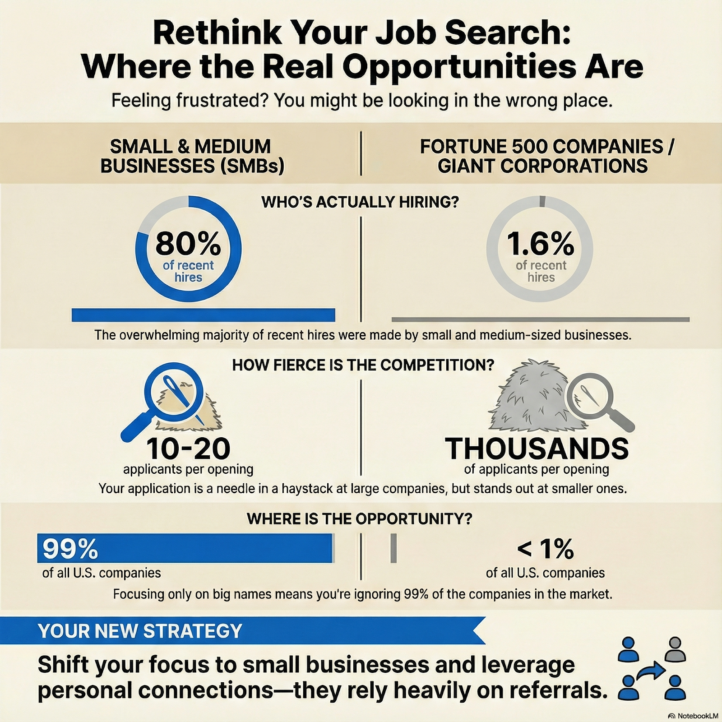
Here’s where the data gets really interesting. The companies doing the bulk of the hiring right now are small to medium-sized. Fortune 500 companies are laying people off, accounting for only 1.6% of hires in the last quarter of 2025, and are drowning in applications.
Meanwhile, small-to-medium-sized companies are doing the bulk of the hiring (they’re hiring is up 9% compared to last year, and they made up 80% of the hires.) They’re also struggling to find qualified candidates and are receiving only 10-20 applicants per opening.
Go back to your target company list and review it. How many of those are small to medium-sized companies?
Also, guess who relies primarily on referrals for their hiring? You guessed it, small businesses.
It’s important to note that small and mid-sized companies account for 99% of companies in the US.
So, if you’re looking at Fortune 500s only, you’ve narrowed your chances of getting hired to only 1% of the market, and that 1% of the market is only doing 1.6% of the hiring. That doesn’t sound like a place with a lot of opportunity.
Not to mention that those same Fortune 500s are the ones who can afford to post on LinkedIn and Indeed, and they’re the ones getting thousands of applications per opening.
The math is not mathing.
If you’re targeting Fortune 500s, you’ve narrowed yourself to 1% of the market, doing the least amount of hiring, with the highest amount of competition.
No wonder job seekers end up feeling frustrated, desperate, and defeated. There’s a better way, friends.
Instead, switch your approach. Target small to medium-sized businesses and talk to the people closest to you. Do they know of any small businesses in your industry that may be hiring? Can they introduce you or refer you to someone inside that company?
Engage strategically, not haphazardly.
This is where we begin to build momentum in your search. You have your two lists: target companies – including small to mid-sized businesses, and your list of the people closest to you.
You’ve reached out to everyone on your list and asked them if they can make an introduction or recommend a company.
They may even know of an opening or know someone hiring, and they can refer you directly.
This happened to me a while ago. I’ve always told my husband that if I didn’t do what I do now, I’d be a teacher.
I’m insanely passionate about teaching. Teaching is why I started my company 17 years ago. I saw too many job seekers missing out on perfect opportunities because they didn’t know what hiring managers were looking for on their resume.
After a delightful conversation with a candidate who stopped by my office (back when you could actually do that!) I asked her to send me her resume. Funny thing was, none of the amazing work she was doing was captured on her resume. It wasn’t doing her justice at all. That was when I decided to teach job seekers what hiring managers need to see on their resumes so great candidates could land great opportunities.
It started with a dream to share what I knew to help others live their best lives.
I still carry that deep desire to share knowledge. In fact, I’ve pretty much made that my mission on LinkedIn. I wrote “teach me” posts before they were a thing, and it’s how I’ve steadily built my audience over the years.
Anyway, I say all that to explain how, many months ago, I was feeling burnt out with the demands of marketing and the noise on social media. I casually mentioned to my husband that I might pray about whether it was time to change careers to teaching.
A week later, he runs into a former client at the grocery store, who asks whether he is still interested in teaching, as she has an opening. He said he was all set with his work at the non-profit, but that I had mentioned a potential change. She called me right up. We chatted for 10 minutes; she never asked to see my resume or interview me, and she offered me a job teaching whatever subject I wanted.
Yes, I realize this is education, and your industry is likely different. I share this story because it demonstrates the power of letting the people in your life know what you’re looking for. Now they can bring your name up in rooms you’re not in, and that can lead to a job offer without an application or even an interview. Obviously, I declined the offer. My heart is still with helping others land faster so they can do what they’re called to do. I just needed to make adjustments and do less so I could get better results. Sound familiar?
Action item: Follow up with anyone you’re introduced to. Mention the person who referred you. Ask for information or advice. Let them offer the referral. This happens way more often than you might think.
Guard your time and energy, avoid time-sucking activities
Take the time that you would have invested in applying for anything and everything online, and take a look at your list of target companies.
- Head to their website and apply for the role directly.
- Reach out to your contact at the company and let them know you’ve applied for the role. Ask them if they’d be kind enough to pass your resume on to the hiring manager.
- After you apply on their website, reach out to the decision-maker/hiring manager directly and let them know you applied.
- Follow up a week later and reiterate why this company and how you can add value.
Do this for each of your target companies.
If you don’t have a contact inside one of your target companies, head over to LinkedIn and go to their company page to see if you already know someone who works there.
If they don’t have a company page, run a LinkedIn search and filter for people who work at the company. See if there’s anyone you already know you can contact.
With small companies, you can email the contact directly. Emails are easy to find on the company website or via tools like Mailscoop.io or Hunter.io.
Resist the urge to scroll and click apply on anything you see. If the job isn’t worth the time to track down a contact or build a relationship with someone inside the company, it isn’t worth the time applying on a major job board. (Yeah, that one’s going to earn me some backlash)
If you are highly interested in the company, add it to your list and begin building relationships.
Search intentionally, not incessantly
There’s substantial data supporting the effectiveness of direct applications, niche job boards, and custom sources. You are 14X more likely to be hired from one of these techniques than from using a major job board.
If you are going to apply, it’s a higher ROI to apply direct on the company page, find and apply via a niche job board, or apply via a Facebook group or industry associate group.
Custom sources refer to places like Facebook pages or groups, Associations, or special industry-related groups. For instance, if I were in marketing, I would use the job board on the American Marketing Association website (or the local chapter, which is even better). It could be a Facebook support group for marketers in Florida.
The challenging part is that you usually haven’t heard of these custom sources or niche job boards. They require some searching.
Action items: Run a search on Facebook for groups related to what you do that are close to you and for job seeker groups in your area. People post in these groups when their companies are hiring, and it’s a great resource for tapping into small-to-medium companies.
Also, head over to Perplexity and run a search for niche job boards in your industry and location. Here’s a search example: Give me a list of marketing job boards, or give me a list of job boards for the Denver area.
Audit your techniques,
I’m a fan of experimenting to see what works best. Track your applications, methods, and responses. If you’ve applied to 80 jobs on Indeed and received 0 responses, you can probably dramatically reduce the time you’re spending there.
If you’ve contacted the people closest to you and it’s led to 5 introductions and 3 interviews, I’d double down on that method.
Go where the data shows you the highest conversion rate. In marketing, there’s a field called conversion rate optimization. It’s about testing different strategies and techniques to see which perform best, then doubling down on the winning variation.
A/B test applying on niche job boards vs. Indeed or LinkedIn. Which gets more responses?
You could A/B test applying direct on a company career page to applying on a niche job board and see which delivers a higher conversion rate of applications to interviews.
Finally, compare these techniques to those conversations with people closest to you and see which delivers the higher response rate.
If job boards get you a 1% response rate and conversations give you a 20% response rate, it makes sense to focus 80% of your time on the technique giving you the highest return.
FAQ’s: Doing less in your job search and still getting results
Can I really get a job if I apply less?
Yes, because your conversion rate on targeted applications and the strategies I mentioned in this article are 5-14X higher than applying on large job boards.
How can I improve my job search?
Instead of spending your time submitting online applications to Fortune 500s on large, high-volume job boards like LinkedIn and Indeed, focus on a smaller, curated list of target companies, having conversations or getting introductions to people inside those companies, and then reaching out to those connections before and after you apply. Also, applying directly on the company career page or via a niche job board or group yields a higher response rate.
What is the #1 most effective job search method today?
By far the most effective method for getting hired in 2026 is through an employee referral. You’re 5X more likely to get hired if you have a referral or recommendation from someone who works inside the company. You’ll also get hired faster, be deemed a better culture fit, and likely stay longer, too.
What should I focus on instead of applying online?
Create a target list of companies, reach out to the people you see regularly and ask them if they know anyone at your target company, reach out to your referral before you apply, and after you apply, contact a hiring manager or decision maker to let them know you applied and who referred you.
How to do less in your job search and feel more productive
If I’ve learned anything over this past year of market fluctuations, it’s that we very easily fall into scrolling, applying, and activities that lead to a false sense of productivity. These, in turn, lead us into a vicious, repetitive cycle of waiting, rejection, and defeat.
I’m not telling you to quit using LinkedIn or Indeed altogether. I’m asking, what if you just did it less? What if you tested out other strategies to see what was more effective at getting interviews? What if you got smarter and more strategic about where you invested your time and chose real results over that false feeling of productivity?
This isn’t about ignoring the big job boards forever or never applying online ever again. It’s about cutting back on the noise, going back to the basics of how hiring is actually happening right now and investing our time wisely into methods and techniques that will give you the greatest conversion rates.
Ready to stop the “Apply, Wait, Repeat” cycle for good?
Your job search deserves a strategy that works for you, not against you. Let me show you how in my free guide: Do Less, Get Hired: The High-ROI Job Search Checklist & Planner.
Because “spray and pray” isn’t an effective strategy. Let’s improve your job search with the most effective job search strategies so you can land a job you love in record time.
Share this post:




About the author
Jessica Hernandez, President, CEO & Founder of Great Resumes Fast
Hi, I’m Jessica. I started this company back in 2008 after more than a decade directing hiring practices at Fortune 500 companies.
What started as a side hustle (before that was even a word!) helping friends of friends with their resumes has now grown into a company that serves hundreds of happy clients a year. But the personal touch? I’ve kept that.
You might have seen me featured as a resume expert in publications like Forbes, Fast Company, and Fortune. And in 2020, I was honored to be named as a LinkedIn Top Voice of the year!
I’m so glad you’re here, and I can’t wait to help you find your next perfect-fit position!
Improve Your Resume: Download Your Free Executive Resume Template Today
Are you struggling to create an executive resume that will impress employers? Download this free executive resume template and receive a series of 10 emails with expert guidance on how to write resume content that resonates with employers so you get more interviews.
It's everything you need to stand out, make an impression, and accelerate your job search.
Work with Us