 A Golden Rule Company
Research: The Job Search Activities That Produce 80% of Results
Last Updated on February 3, 2026 by Jessica Hernandez
20% of your job search activities produce 80% of your results. Here’s how to identify which activities actually move the needle and which ones are just keeping you busy.
You’re spending 15+ hours a week on your job search, you’ve applied to 47 jobs in the last month, customized every resume, matched every keyword, and written more cover letters than you care to admit. You even followed up when you could figure out who to follow up with. And what do you have to show for all that effort? Maybe one or two responses.
Meanwhile, you hear about someone else who applied to 5 jobs and got 3 interviews. What are they doing that you’re not?
They’ve figured out which 20% of activities produce 80% of results, and they’re ignoring the rest.
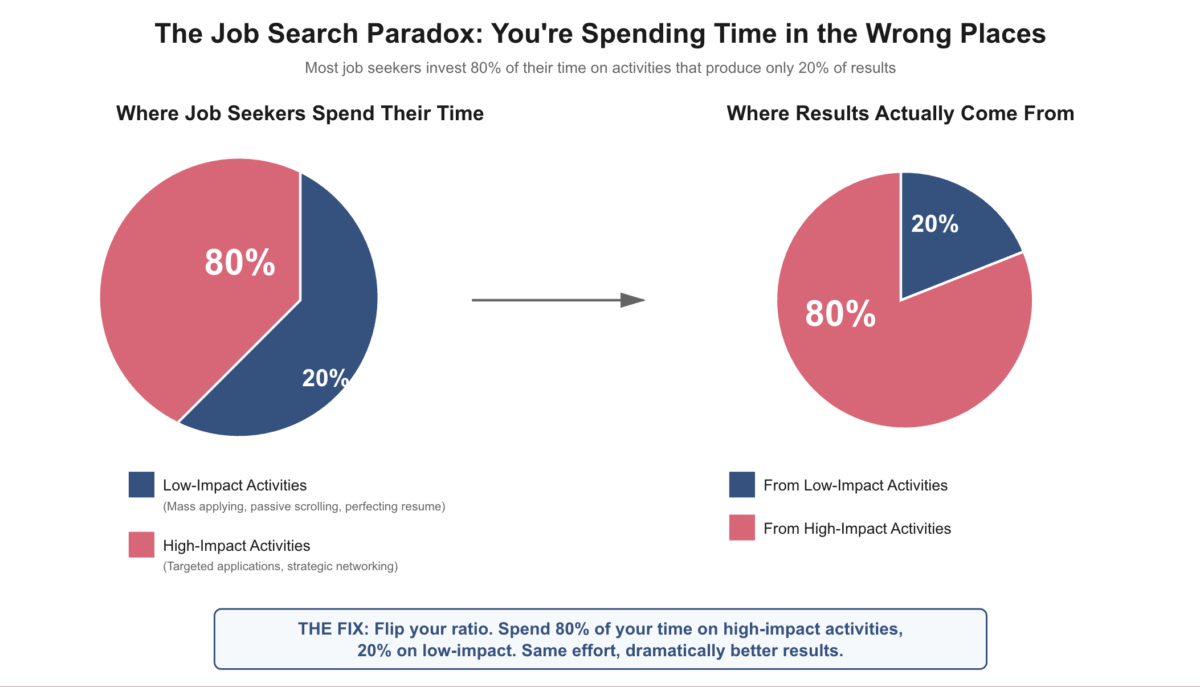
What I’ve seen lately in my 1:1 coaching session and in discussions with job seekers is that they’re working backwards. They’re spending 80% of their time on activities that produce 20% of results.
If that’s you today, let me show you how to flip that.
What Is the 80/20 Rule? (And Why It Matters in Job Searching)
The 80/20 Rule, also called the Pareto Principle, is simple: 80% of your results come from 20% of your efforts.
This shows up everywhere:
- 80% of sales come from 20% of customers
- 80% of productivity happens in 20% of work time
- 80% of impact comes from 20% of actions
And in job searching? 80% of interviews and offers come from 20% of the activities you do.
The problem is that most job seekers spend their time on the WRONG 20%.
They focus on:
- Scrolling job boards for hours
- Applying to every remotely relevant position
- Endlessly tweaking their resume
- Refreshing their email, hoping for responses
These activities FEEL productive and they sure do keep you busy ( job searching feel like a full time job, anyone?). They make you feel like you’re “doing something.”
But busy doesn’t equal effective. The job seekers who land roles in less than 6 months? Research says they’ve identified the 20% of effective job search activities that actually produce results and ruthlessly prioritize them.
The High-Impact 20% vs. The Low-Impact 80%
Let me show you what I mean.
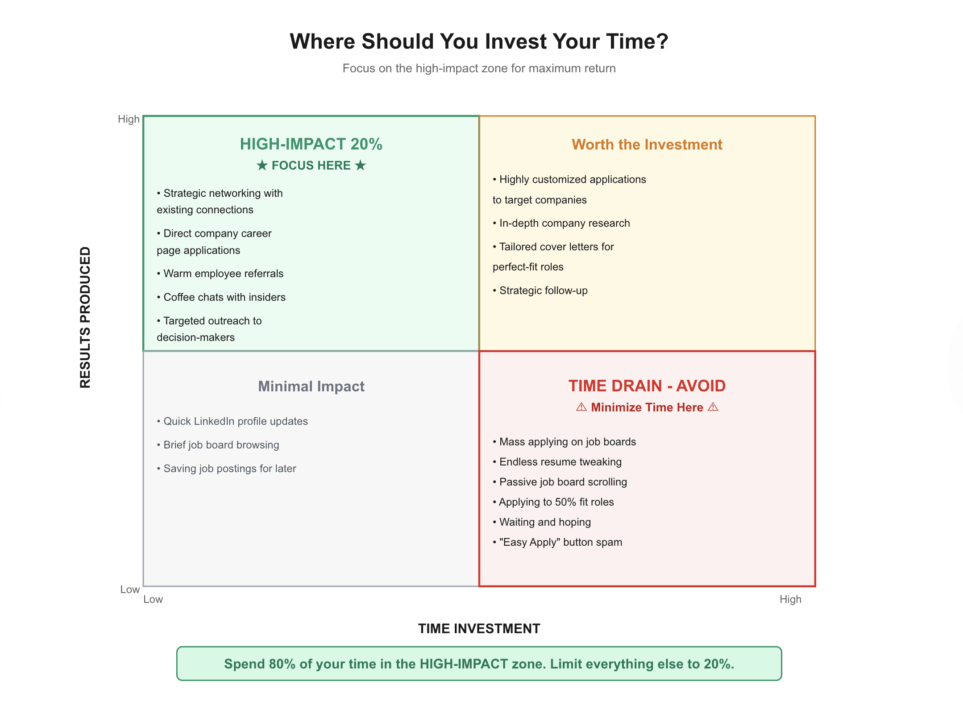
Low-Impact Job Search Activities (The 80% That Produce 20% of Results):
- Applying to jobs on LinkedIn and Indeed
- Spending hours perfecting your resume format
- Endlessly scrolling job boards without a strategy
- Waiting and hoping someone will respond
- Applying to jobs where you’re 50% qualified “just in case”
These activities have a place. But if they’re taking up 80% of your time, you’re doing it backwards.
High-Impact Job Search Activities (The 20% That Produce 80% of Results):
- Identifying specific target companies and roles where you’re 75%+ qualified
- Reaching out to your existing network about specific opportunities
- Applying through channels that have higher success rates than job boards
- Following up strategically with company contacts where you’ve applied
- Having conversations with people inside your target companies
Notice the difference?
Low-impact activities are passive. You’re waiting for something to happen.
High-impact activities are active. You’re making something happen.
Low-impact activities are also haphazard. You’re applying everywhere, hoping something sticks. It’s like that saying, you’re throwing spaghetti at the wall to see what sticks.
High-impact activities are targeted. You’re going after specific opportunities strategically.
Every piece of research I can find shows that successful job seekers (those who land offers in under 6 months) spend LESS time on their search than unsuccessful ones. Yes, even in this tight labor market.
How is that possible? Because they’re not wasting time on the 80% that doesn’t work.
Why You’re Probably Focused on the Wrong Activities
I get it. You’re probably thinking: “But Jessica, I NEED to apply to lots of jobs. That’s how you increase your odds, right?”
Actually, it’s not. This is the trap most job seekers fall into. They think: More applications = More chances = Better odds
But if you’re applying through channels with a <3% success rate?
Then 100 applications = 3 chances
While 10 strategic applications through better channels = 5-7 chances
We don’t want to play a numbers game. We want to play a strategy game. I want you to know which job search techniques are a waste of your time and which are a wise investment of your time and energy.
Here’s why most people focus on low-impact activities:
- They’re easy and require no strategy. Anyone can click “Easy Apply” on LinkedIn. It takes 30 seconds. But those applications also get the worst results.
- They feel productive. “I applied to 20 jobs today!” feels like progress. But if none of those 20 lead anywhere, was it really progress?
- They’re what everyone else is doing. If everyone’s on LinkedIn, that must be where the jobs are, right? (Spoiler: It’s not where most hiring happens.)
- You don’t know what else to do. No one teaches you the high-impact activities. So you default to what’s obvious and easy.
And the result I’m hearing from thousands of job seekers? You’re telling me: “I’m busy, exhausted, and frustrated with nothing to show for all that effort.”
How to Identify YOUR High-Impact 20%
The good news is once you know WHICH activities actually produce results, you can reallocate your time and energy there.
Try this exercise right now:
Step 1: List every job search activity you did in the last week.
Examples:
- Applied to 15 jobs on LinkedIn
- Spent 3 hours updating resume
- Searched Indeed for 2 hours
- Reached out to 2 former colleagues
- Applied directly on 3 company websites
- Had a coffee chat with someone in my target industry
- Followed up on 5 applications from last month
Step 2: Next to each activity, write down what result it produced.
Examples:
- Applied to 15 jobs on LinkedIn → 0 responses
- Spent 3 hours updating resume → No change in results
- Scrolled Indeed for 2 hours → Applied to 3 jobs, 0 responses
- Reached out to 2 former colleagues → 1 responded, led to a warm introduction
- Applied directly on 3 company websites → 1 phone screening scheduled
- Coffee chat with someone in target industry → Got 2 company recommendations I hadn’t considered
- Followed up on 5 applications → 1 rejection email, 4 silence
Step 3: Circle the activities that produced actual results.
Not “felt productive.” Not “seemed like the right thing to do.”
Actual results = responses, conversations, introductions, interviews, or new opportunities.
Step 4: Look at your circled items. That’s your high-impact 20%.
Now ask yourself: What percentage of my time am I actually spending on these high-impact activities?
For most people, the answer is: Not enough.
The Time Reallocation Strategy
Once you’ve identified your high-impact job search activities, here’s what to do:
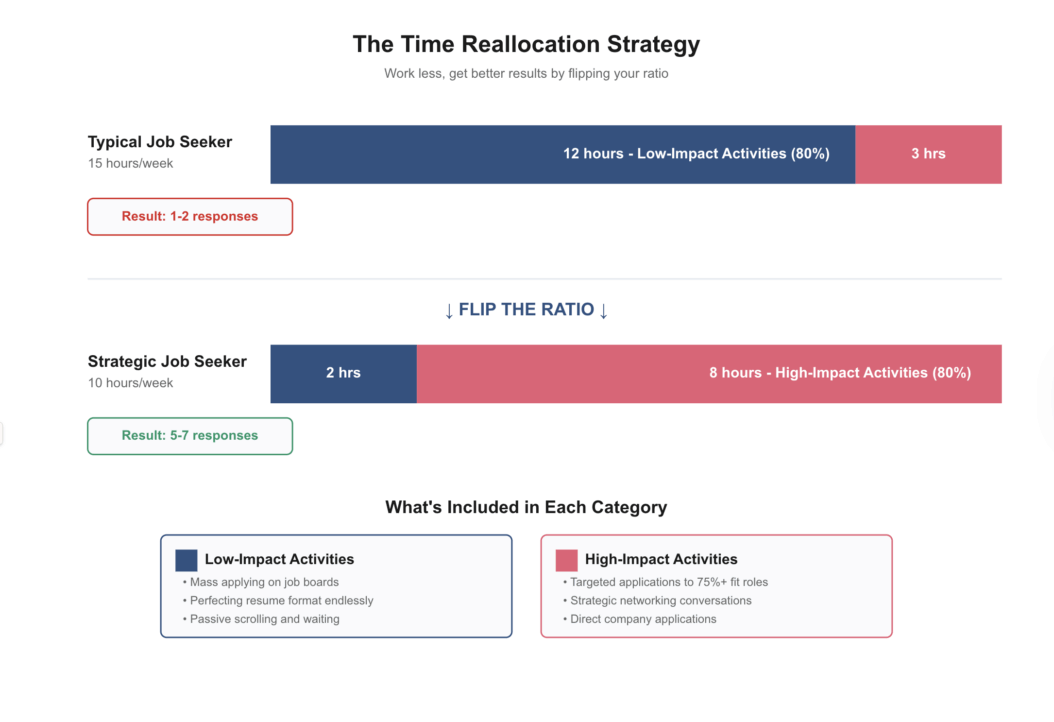
Flip your ratio.
If you’re currently spending:
- 80% of your time on low-impact activities (lots of applying on LinkedIn and Indeed)
- 20% of time on high-impact activities (strategic networking, targeted applications)
Switch it:
- 20% of time on low-impact activities
- 80% of time on high-impact activities
What this might look like in practice:
OLD APPROACH (Low-Impact Focus):
- Monday: 2 hours applying to jobs on LinkedIn (15 applications)
- Tuesday: 2 hours scrolling job boards, applying to 10 more
- Wednesday: 1 hour tweaking resume again, 1 hour applying to 8 jobs
- Thursday: 2 hours on Indeed, 12 applications
- Friday: 1 hour following up on old applications, 1 hour applying to 5 more
Total: 50 applications, mostly through low-conversion channels = Maybe 1-2 responses if you’re lucky
NEW APPROACH (High-Impact Focus):
- Monday: 1 hour identifying 5 target companies, 30 minutes mapping connections to those companies
- Tuesday: 45 minutes reaching out to 3 people in your network about target companies, 45 minutes researching those companies
- Wednesday: 1 hour having a coffee chat (virtual or in-person) with a connection at one target company
- Thursday: 1 hour applying directly on 3 company career pages with customized resumes, 30 minutes following up with another network contact
- Friday: 1 hour reaching out to 2 more strategic contacts, 30 minutes applying to 2 more targeted roles
Total: 5-8 highly targeted applications through better channels + 5-6 strategic conversations = 3-5 responses/opportunities
Same amount of time invested and dramatically different results.
The One Question That Changes Everything
Here’s the question I want you to ask yourself before every job search activity: “Is this likely to get me in front of a decision-maker, or is this just making me feel busy?”
If the honest answer is “just making me feel busy,” cut it.
Examples:
- Spending 2 hours perfecting your resume format? Busy work. (Unless you’re submitting it somewhere specific that day)
- Scrolling LinkedIn for “inspiration”? Busy work.
- Applying to 20 jobs you’re 50% qualified for? Busy work that feels like progress.
- Reaching out to a former colleague who works at your target company? High-impact action.
- Applying directly on a company career page where you’re 80% qualified? High-impact action.
- Having a 20-minute conversation with someone who can introduce you to a hiring manager? High-impact action.
It’s easy to confuse activity with progress, especially when you’re working so hard. But they’re not the same thing.
Your job search should be measured by outcomes (interviews, conversations, opportunities), not outputs (number of applications sent).
Read that sentence again, friend.
Your job search should be measured by outcomes (interviews, conversations, opportunities), not outputs (number of applications sent).
What This Means for Your Job Search
If you’ve been job searching for weeks or months with little to show for it, I want you to hear this:
You’re not failing because you’re not working hard enough.
You’re struggling because you’re working hard on the wrong things.
We can change that. Once you identify your high-impact 20%, you can:
- Spend less time job searching (because you’re not wasting hours on activities that don’t work)
- Get better results (because you’re focused on what actually produces interviews and offers)
- Feel less exhausted and frustrated (because effort that produces results is energizing, not draining)
Most job seekers are stuck in a cycle of: Do more → Get no results → Feel defeated → Do even more → Still get no results → Burn out
Break the cycle.
Do less. But do the right things.
Your Action Step for This Week
Here’s what I want you to do this week:
Do the audit exercise I outlined above.
Spend 15 minutes listing every job search activity from last week and what result it produced.
Then ask yourself:
- What’s working? (Even if it’s just one thing)
- What’s not working? (Be honest)
- Where am I spending most of my time?
- Where am I actually getting results?
Once you see the gap between where your time is going and where your results are coming from, you’ll know exactly what to change.
And if you’re realizing “I’ve been spending 90% of my time on activities that produce 10% of results,” don’t beat yourself up.
You didn’t know. Now you do.
The job seekers who land roles quickly aren’t smarter than you. They’re not working harder than you.
They’ve just figured out which 20% of activities to focus on and they’re ruthlessly prioritizing those.
You can do the same.
Want to know exactly which activities produce the highest return in today’s job market?
I’ve analyzed the research on where hiring is actually happening and which channels have the highest success rates. (Hint: Job boards aren’t in the top 3.)
I’m putting together a comprehensive guide on the high-impact strategies that get job seekers hired in under 6 months. If you want to be the first to know when it’s ready, join my newsletter here, and I’ll let you know when it’s finished.
In the meantime, do that audit exercise. It’ll change how you think about your job search.
You’ve got this.
Jessica
P.S. Whenever you’re ready, here’s how we can work together: Our clients land roles they love (faster and with more confidence) because their resume and LinkedIn profile tell a story hiring managers can’t ignore. Let’s craft yours: Book your Resume Strategy Session →
Share this post:



About the author
Jessica Hernandez, President, CEO & Founder of Great Resumes Fast
Hi, I’m Jessica. I started this company back in 2008 after more than a decade directing hiring practices at Fortune 500 companies.
What started as a side hustle (before that was even a word!) helping friends of friends with their resumes has now grown into a company that serves hundreds of happy clients a year. But the personal touch? I’ve kept that.
You might have seen me featured as a resume expert in publications like Forbes, Fast Company, and Fortune. And in 2020, I was honored to be named as a LinkedIn Top Voice of the year!
I’m so glad you’re here, and I can’t wait to help you find your next perfect-fit position!
Improve Your Resume: Download Your Free Executive Resume Template Today
Are you struggling to create an executive resume that will impress employers? Download this free executive resume template and receive a series of 10 emails with expert guidance on how to write resume content that resonates with employers so you get more interviews.
It's everything you need to stand out, make an impression, and accelerate your job search.
Work with Us