 A Golden Rule Company
What Hiring Managers Want to See on Your Resume in 2026
Last Updated on July 23, 2026 by Jessica Hernandez
See the four questions hiring managers ask in the first ten seconds of reading your resume, how to answer all four in your top third, plus exactly what hiring managers want to see on your resume in 2026.
One of my clients walked into an interview confident their resume communicated their value. Five minutes in, the interviewer said, “This resume doesn’t represent you at all.”
My client froze… nervous, concerned, and a little scared. The interviewer added, “You’re clearly much smarter than this document shows. I almost didn’t interview you.”
Luckily, they made it to the second round. But the experience revealed a crucial truth: your resume can unintentionally undersell your abilities. In a ResumeGo survey of 418 hiring professionals, over 70% of recruiters said they “almost always” or “often” skim a resume instead of reading it fully. If your top third doesn’t answer their questions fast, you lose the interview before you ever walk into the room.
Why Your Resume Might Be Holding You Back
Many resumes today follow a similar pattern: job titles, responsibilities, and lengthy lists of duties. But hiring managers aren’t looking for a list of your past duties. They want to know:
- Can you deliver results?
- Do you have the skills and experience to solve their problems?
- Will you bring unique value to the team?
If your resume only lists what you did, not what you achieved, it is silently failing you. Even qualified, top candidates can be overlooked if their impact isn’t immediately clear.
When I was an HR manager, I had a very similar situation to my client, except I was on the other side of the table. A candidate stopped by (back when you could actually do that) to apply for an opening.
We chatted for a few minutes, and she had the exact experience my company needed. I asked to see her resume, and I was shocked. None of the accomplishments, experience, or skills we’d just discussed were conveyed on her resume.
Her resume wasn’t doing her justice at all. That was the moment I knew for certain that I would do everything in my power to teach job seekers what hiring managers were looking for in resumes.
Okay, real talk (this is your sign). If your resume is still listing duties instead of results, it’s costing you interviews you’re 100% qualified for. My free executive resume template shows you exactly how to fix that, no guesswork, no staring at a blank page. Grab it, plug in your wins, and watch what happens. 👇
What Do Hiring Managers Look For in a Resume in 2026?
During the initial scan, a hiring manager is asking four specific questions. Answer all four, and you’ll get the call for an interview.
1️⃣ What role are you targeting? Include a clear target job title at the top. Make your headline or summary role-specific. Skip generic phrases like “Experienced professional”. These phrases are what we call fluffy resume speak. That don’t add value, specificity or proof to your resume. It’s better to state the exact job title.
2️⃣ What impact have you made? Highlight 2–3 major results from past roles, using metrics wherever possible: revenue growth, cost savings, team scaling. Show how you solved a problem or drove a change.
3️⃣ Do you have the right skills and expertise? List your top hard skills near the top. Include certifications, tools, and technologies by name, so both a recruiter and an applicant tracking system can find them.
4️⃣ Can you deliver in the future? Include concise bullets that show measurable outcomes. Highlight recent wins, promotions, and scaled responsibility — employers judge future performance by past performance.
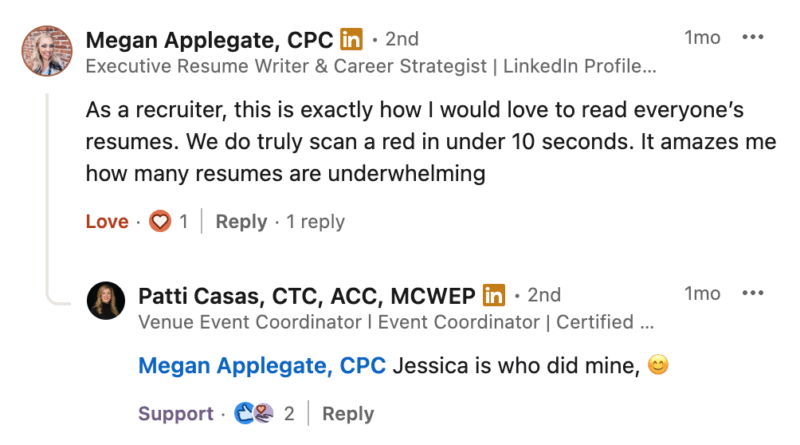
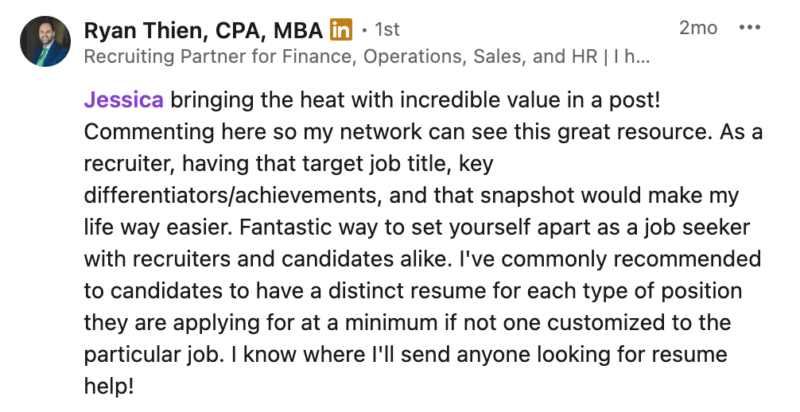
These four questions should be answered in the top third of your resume. When I shared this framework on LinkedIn, two recruiters confirmed it in the comments: one said this is exactly how she reads a resume and that recruiters really do scan in under 10 seconds; another said having a target title and clear differentiators up front makes his job significantly easier.
When I mentioned this on LinkedIn, here’s how two recruiters responded:
How to Make Your Resume Stand Out in 2026
The goal is a “showcase” section in your resume’s top third that answers all four questions at once, so a hiring manager’s first thought is, “This is exactly who I’ve been looking for.”
Step 1: State your target role. Add your target job title and three high-priority skills to the very top. Underneath, add a personal branding statement built around your differentiators — something that couldn’t be said about anyone else. My free executive resume template shows exactly how this is structured.
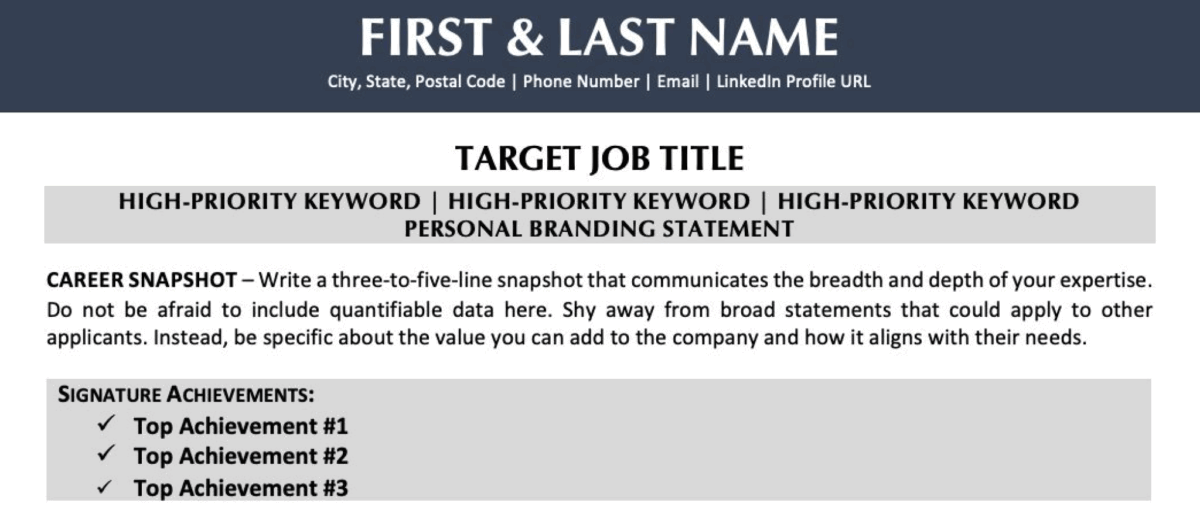
Step 2: Lead with impact. Build a “Significant Accomplishments” section with three results most relevant to your target role, placed right under your summary. You have to connect the dots for hiring managers — they will not do it for you.
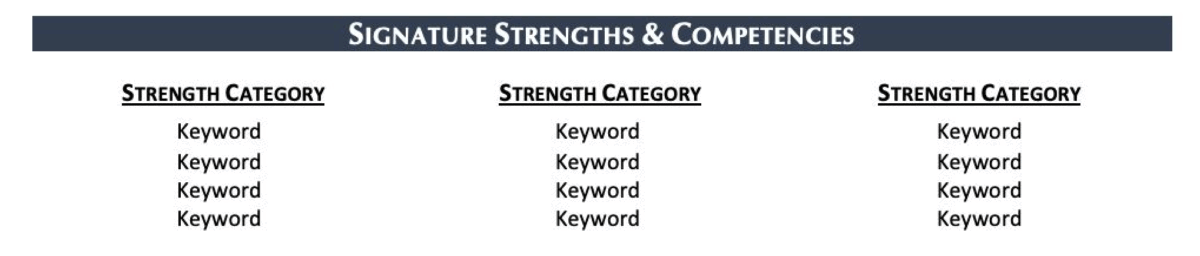
Step 3: Highlight relevant skills. Create a separate core skills section with both technical and leadership skills. Identify the top three hard skills the role requires and place them underneath your target job title, then build out a core strengths section beneath it.
Step 4: Prove future success. Write results-focused resume bullets that spotlight achievements tied directly to the role’s needs. Add metrics, data, and figures — recruiters treat unquantified bullets as unverifiable.
Duties vs. Results: What Changes on the Page
| What Most Resumes Say | What Gets Interviews |
|---|---|
| “Managed a team” | “Directed a 15-person team across 3 departments in 2 locations” |
| “Improved processes” | “Streamlined reporting from 5 hours to 30 minutes, saving 18 hours monthly” |
| “Handled projects” | “Managed 6 concurrent projects ranging $50K–$250K with 8+ stakeholders each” |
Each result on the right uses size, time, or scale to make the metric concrete. You can use the same approach with frequency, volume, quality, complexity, or resources managed — whichever dimension actually proves your impact.
In my experience reviewing resumes for candidates at every career stage, including those navigating ageism, the biggest gap isn’t a lack of achievements. It’s that candidates assume “I didn’t hit a revenue number, so I have no numbers to use.” Hiring managers don’t care what you were “responsible for.” They care what you delivered ~ and an ATS applicant tracking system is built to search for exactly that proof.
I want to remind you again that employers will judge your future performance based on your past performance. So the way you convey your past performance will help them judge your future success with their company.
Within each resume bullet, you want to add metrics, data, and figures to prove that your results are repeatable and verifiable. 87% of job seekers get this wrong because they assume that if they didn’t generate revenue, then they have no numbers.
Client Example: How This Played Out in Real Life
Carlos came to Great Resumes Fast from a $40K military career, and after applying this same approach across several career moves, he eventually stepped into a $1.6M CEO position. Along the way, he moved from $50K to $175K in three years and now runs a regional logistics and supply chain network spanning 12 states with an account valued above $160M.
The shift wasn’t more experience; it was making the experience he already had visible in the top third of his resume. That’s the same move available to any candidate willing to quantify their wins instead of listing their duties.
Action Steps You Can Take Today
- Identify your target role and add it to your headline/summary.
- Pick 2–3 key achievements and quantify them.
- Update your experience bullets to show measurable results.
- List core skills prominently at the top.
Even small changes here can meaningfully increase your interview rate. The goal: In 15-20 seconds, your resume communicates who you are, what you’ve achieved, and why you’re the right fit.
Hiring managers in 2026 are scanning resumes faster than ever, and nearly every application now passes through an ATS before a human sees it ~ Jobscan’s 2025 State of the Job Search report found 99.7% of recruiters use keyword filters to sort candidates. Resumes that don’t immediately show impact, skills, and fit get quietly filtered out. Target the right role, lead with results, and prove your future success ~ that combination is what survives both the software and the scan.
FAQs: What Hiring Managers Want to See on Your Resume in 2026
Q: What do hiring managers look for in a resume? A: They want to know what role you’re targeting, the impact you’ve made, whether your skills match the role, and proof you can deliver results — all answered within the resume’s top third.
Q: What are red flags on a resume? A: Missing a job title at the top, no relevant keywords or skills for the role, and duty-lists with no measurable results. Each signals to a hiring manager that you may not be a fit before they read further.
Q: What looks unprofessional on a resume? A: Marital status, age, a headshot, unrelated hobbies, or an unprofessional email address. Resumes are also written in implied first person ~ skip “I,” “me,” and “my” throughout.
Q: What’s working for a resume in 2026? A: Answering four questions in the top third: your target role, your impact, your relevant skills, and proof you can deliver. Candidates who structure around these four consistently get more callbacks.
Q: How long do recruiters actually spend reading a resume? A: ResumeGo’s 2024 survey found most hiring professionals spend under a minute per resume during initial screening, and over 70% skim rather than read fully… which is why the top third carries the weight.
I’m going to be honest with you: most resumes aren’t bad because the person isn’t qualified. They’re bad because nobody taught them how to show it. This template is the shortcut (79,900 job seekers have already used it). Download it, steal the structure, make it yours. [Grab My Free Template]
Share this post:


About the author
Jessica Hernandez, President, CEO & Founder of Great Resumes Fast
Hi, I’m Jessica. I started this company back in 2008 after more than a decade directing hiring practices at Fortune 500 companies.
What started as a side hustle (before that was even a word!) helping friends of friends with their resumes has now grown into a company that serves hundreds of happy clients a year. But the personal touch? I’ve kept that.
You might have seen me featured as a resume expert in publications like Forbes, Fast Company, and Fortune. And in 2020, I was honored to be named as a LinkedIn Top Voice of the year!
I’m so glad you’re here, and I can’t wait to help you find your next perfect-fit position!
1 Comment
Leave a Comment
Improve Your Resume: Download Your Free Executive Resume Template Today
Are you struggling to create an executive resume that will impress employers? Download this free executive resume template and receive a series of 10 emails with expert guidance on how to write resume content that resonates with employers so you get more interviews.
It's everything you need to stand out, make an impression, and accelerate your job search.
Work with Us




Such a helpful read! I’m an HR manager, and I really appreciate how clearly you broke down what hiring managers actually look for in 2026. In every CV search, I go through thousands of resumes, and the ones that show real impact and clear results stand out. I think this kind of useful tips really helps candidates present their value better. Love these tips