 A Golden Rule Company
How to Stop Getting Rejected for Being Overqualified
Last Updated on January 4, 2026 by Jessica Hernandez
“You’re overqualified.”
If you’re a 50+ job seeker, I can guarantee you’ve heard this phrase from an employer before. Probably alongside a rejection email that says, “We went with another candidate whose qualifications more closely matched the requirements for the role.”
The overqualified label is coded language for age discrimination, which is unfortunately running rampant in the job market right now. In today’s article, I’m equipping you with the best strategies for how to stop getting rejected for being overqualified. So, let’s jump in.
Part 1: How to Stop Getting Rejected for Being Overqualified
Rejection due to being overqualified occurs in two ways. The first way is when they take a look at your resume and your years of experience, credentials, or degree exceed those required for the job and they pass you over. They do this because they’re worried you’ll get bored, want too much money, or leave the first chance you get. They’re trying to avoid a risk.
The second type of rejection is when you make it to the interview but don’t get the offer. The feedback you hear (if you get any) is that you’re overqualified, they’re looking for someone more junior (less expensive), or they went with another candidate whose qualifications more closely matched the role.
This means they had unaddressed fears.
Employers fear 3 things about “overqualified” candidates:
1. Flight risk (you’ll leave when something better comes or you’ll be bored)
2. Salary expectations (you’ll want VP money)
3. Management issues (you won’t respect younger bosses)
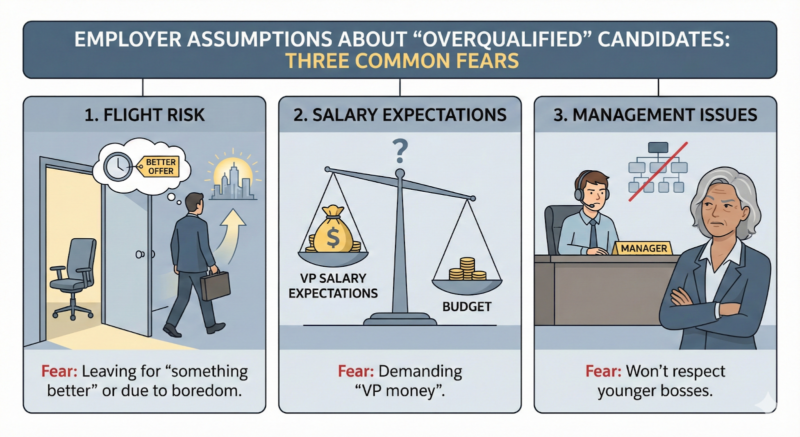
To address their fears and stop getting rejected for being overqualified, we have to address it in three different ways. The first is to eliminate age signals on your resume so you get past the initial screening and make it into the interview.
Grab my executive resume template that’s built to help you overcome age bias. You can download it for free here.
Eliminate Age Signals on Your Resume
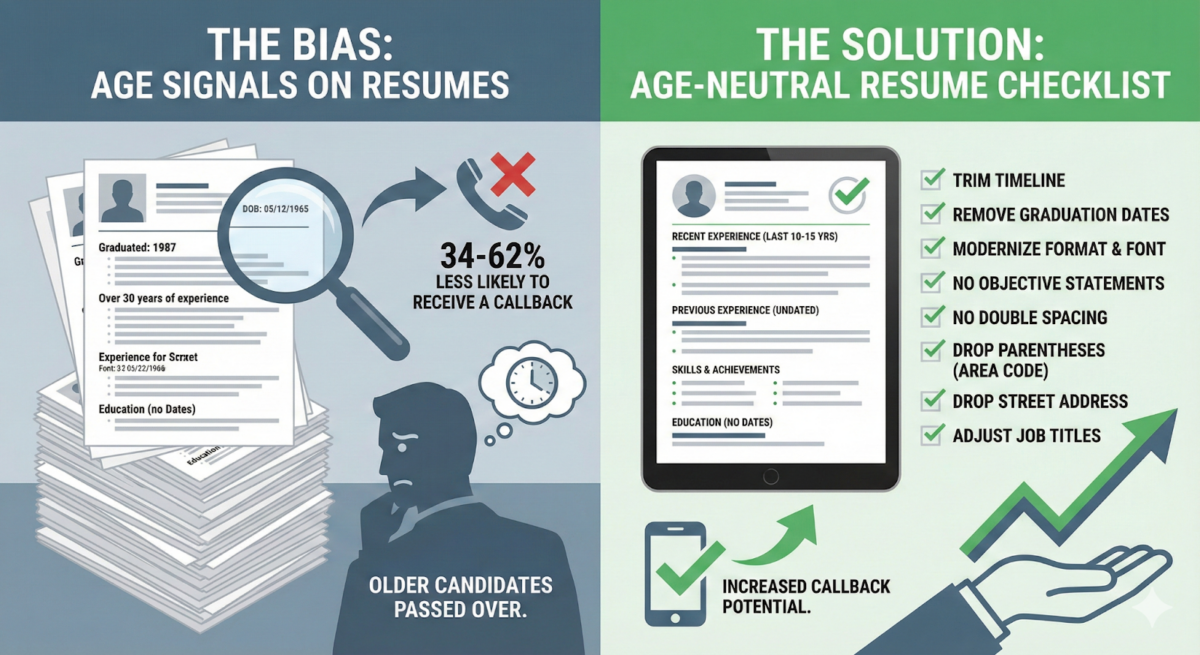
We know from one of the most extensive research studies on ageism in hiring that when resumes contain age signals, older candidates were 34-62% less likely to receive a callback than younger candidates. The difference is based on the candidate’s age. The older a candidate was, the higher the odds they would not get a callback.
This bias occurred even when skills were identical. Since the researchers used fictitious resumes where the only variable changed was the age signal (date of birth or graduation date).
One of the smartest things you can do to combat being passed over in a hiring manager’s initial review of your resume is to remove any and all age signals from your resume.
Here’s a checklist for removing age signals from your resume:
Trim your timeline so that only the most recent 10-15 years of experience have dates.
Abbreviate experience past the 15-year mark and include it in a “Previous Experience” section. Only include relevant accomplishments and do not date this section.
Remove references to years of experience from your career summary. Do not say, “Over 30 years of experience” in your summary.
Remove graduation dates from your resume.
Avoid outdated fonts like Times New Roman or Garamond
Modernize your formatting and resume design to use newer formats.
Do not include objective statements.
Avoid double spacing (this is a holdover from typewriter days)
Drop the parentheses around the area code on your telephone number (this is a holdover from when area codes weren’t necessary – and those days are long gone).
Drop the street address. It’s more modern to only include city, state, and zip code. Plus, if you live in an active senior community like Del Webb, you don’t want recruiters searching your address and seeing it.
Adjust job titles to more closely reflect/describe the work you did. Job titles can be inflated in small businesses. For example, you were a Director of Marketing at a mid-sized firm, and the equivalent role in a Fortune 500 would be marketing manager.
Use my free executive resume template to help you design a resume that’s not focused on age but instead focused on value.
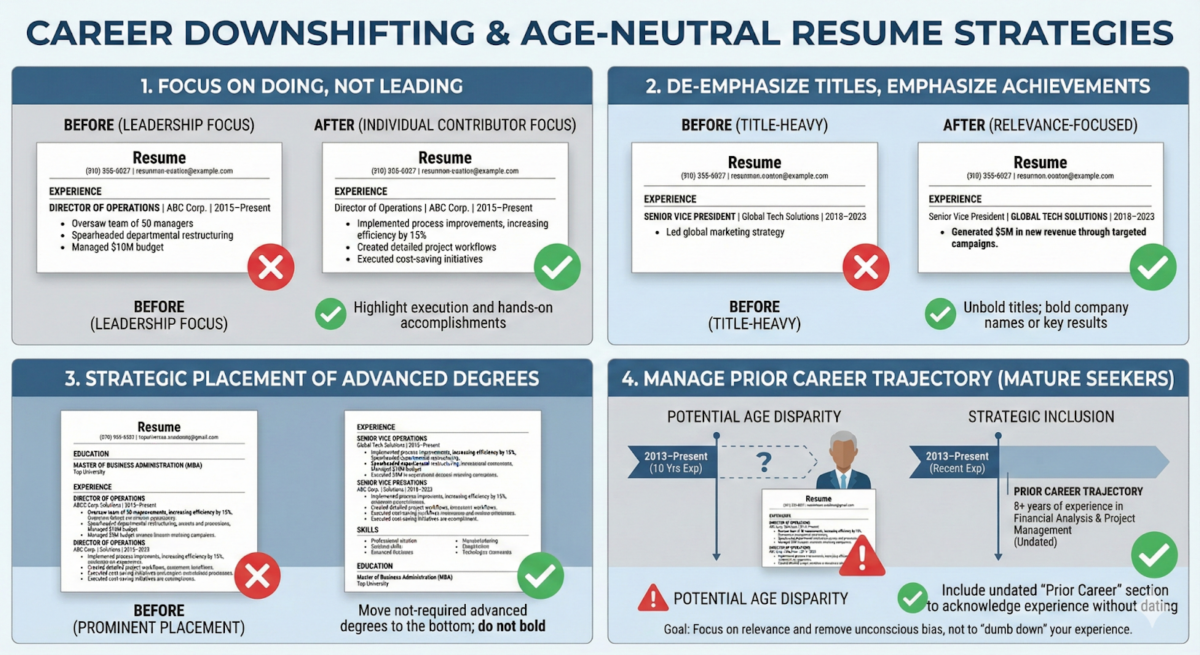
If you’re downshifting in your career:
Focus your resume bullets on doing, not leading. Share accomplishments that reflect an individual contributor.
Unbold job titles to take the focus off the title and instead bold the company name or the most noteworthy and relevant accomplishments.
If you hold an advanced degree not required for roles you’re targeting, move it from a place of prominence in the top third of your resume into the education section at the bottom. Don’t bold the degree. This removes the focus from the degree. You don’t have to dumb down your resume to apply for roles where you have more experience than is required. You simply need to focus on what’s most relevant to the role and remove the focus from what isn’t a priority.
One more critical tip about age signals and your resume
While you’re only dating the most recent 10-15 years, if you’re a mature job seeker, make sure you include a few details on your prior career trajectory. In other words, if your resume only shows 10 years of experience total, and you walk in at 58 with gray hair, there’s going to be a considerable disparity there between the resume, the hiring manager’s expectations, and who you are as a candidate.
You can reduce this disparity by including a previous experience or “prior career trajectory” section without employment dates. Instead, state 8 years of experience in (industry or function), or you could say 5+ years of experience in (industry or function). This lets them know there was prior experience without dating yourself, and there won’t be as significant an age disparity.
Part 2: How to Stop Getting Rejected for Being Overqualified
Own your story and control the narrative
I often hear job seekers say they didn’t hear they were “overqualified” for the role until they got the rejection call. At this point, it’s too late to do anything about it. What’s happening is that employers have questions and concerns on their mind, but they’re not asking you outright about them. You have to enter the conversation going on in the interviewer’s mind and proactively address any fears they may have about your candidacy.
If you’re downshifting in your career, applying for a role where you’ve been at a higher level, or you’re a mature worker, it’s critical that you overcome the myths, biases, and fears the hiring manager has about you.
We know the main objections employers have to hiring someone they perceive as overqualified:
- Flight risk (you’ll jump ship the first time something better comes along/get bored easily)
- Salary expectations (you’ll want more than they can afford to pay you)
- Managed by someone younger/less experienced than you (you won’t take direction)
Thankfully, these are easy to overcome in your cover letter and your interview. In part one, we addressed how to remove age signals from your resume to increase the chances you’ll get the interview. But, overcoming the overqualified label isn’t just about your resume. You need to overcome their objections in your cover letter, LinkedIn profile, and in the interview.
In your cover letter:
Express excitement/enthusiasm about the role. This helps combat any preconceived notions or worries you’ll be bored. It also overcomes some ageist assumptions about energy.
Explain why this role and why right now. It puts the focus on what you can/will do for them.
Depending on how bold you’re feeling you could adapt this script and include it in your cover letter when applying to a job where you’re going to appear overqualified:
Why this role? Because you need someone who can see around corners. I’ve already made the expensive mistakes at someone else’s company. I know which shortcuts end in disaster and which processes actually scale.
Why now? My kids are grown. My mortgage is paid. I’m not chasing titles or stock options anymore. I’m chasing the satisfaction of doing work that matters with people who value experience over ego.
I encourage you to make the “why this role” even more specific to the company and position. Point out values-alignment, too. Studies show that cover letters mentioning a values alignment lead to more interviews.
Overcome their fears
1. Flight risk: “I’m intentionally downshifting because [specific reason]. This isn’t a stepping stone, being a part of (Company Name) is about of my 5-10 year vision for my career.”
2. Salary expectations: “I’ve made my money. I’m optimizing for [culture/impact/balance] now, not maximizing compensation.”
3. Management concerns: “The best leaders I’ve worked under were [younger/less experienced]. I’m here to contribute/mentor, not compete.”
𝗧𝗵𝗲 𝗖𝗹𝗼𝘀𝗲: “You need someone who [specific value you bring]. I’ve already learned those lessons the expensive way. Let me save you the tuition.”
In your interview:
Address any concerns about boredom or flight risk by explaining what excited you about this specific role right now and your 5-10 year plan.
That could sound like:
I’ve run the $100M divisions and managed the 200-person teams. What excites me about this specific role is going deep on [specific aspect of their role] without the politics and bureaucracy that comes with executive positions.
My plan for the next 5-10 years? Become your subject matter expert in [specific area]. Build and refine systems that outlast me. Mentor the next generation without the pressure of succession planning. I want to be known as the person who solved [specific company challenge], not the person who climbed another rung.
I’m at the stage where I measure success differently. It’s not about the next role up – it’s about mastery, impact, and honestly, having dinner with my family more than twice a week. This role offers exactly what I’m optimizing for: challenging work in my zone of expertise, without the parts of executive life I’m deliberately leaving behind.
Talk about mentoring and why it’s important to you. This overcomes the fear that you won’t want to work with a younger boss.
At this stage of my career, I find mentoring incredibly fulfilling. Not the formal, top-down kind – but the organic exchange that happens when experienced professionals and emerging leaders actually listen to each other.
I’m not here to tell anyone ‘how we used to do things.’ I’m here to combine what’s worked for decades with what’s working now. That only happens when you respect the person leading, regardless of their age.
Some of my proudest moments have been watching younger colleagues take concepts I’ve shared and improve them in ways I never imagined. That’s not threatening to me – that’s the whole point.
Remember to talk about potential. What’s in it for them? Talk about what you can do, will do, or are excited to do. We know from research studies that candidates who have/share potential are more likely to get hired.
If you’ve just completed a certification or credential share how excited you are to use it at the company. They can fill in the gap with the positives of what that could mean.
The formula: “I’ve done/completed [specific achievement with numbers or new credential]. I can/will [apply this to their specific situation], or I’m excited to [learn or tackle their unique challenge].”
Reframe overqualified. In most cases, they won’t come out and say it explicitly, but in their mind they’re asking themselves the question why someone with your qualifications wants this role. So, answer the question they’re not asking. Here’s one of my favorite ways to bring this up in conversation:
“You might be wondering why someone with my background/experience/credentials wants this role. What excites me about this role is…”
Then fill in the blank honestly and authentically about what this role lets you do that you’re excited about. You’ll address their unspoken worries and overcome the overqualified objection. They’ll see your experience as an asset rather than a risk or liability.
Part 3: How to Stop Getting Rejected for Being Overqualified
Use age-smart job search techniques to move your search forward faster.
You can update your resume to remove age signals and lessen the chances you’ll be passed over as overqualified but you have to combine resume strategies with job search strategies. A successful job search is not solely reliant on a great resume; you also need a solid search strategy.
Target companies that value experience
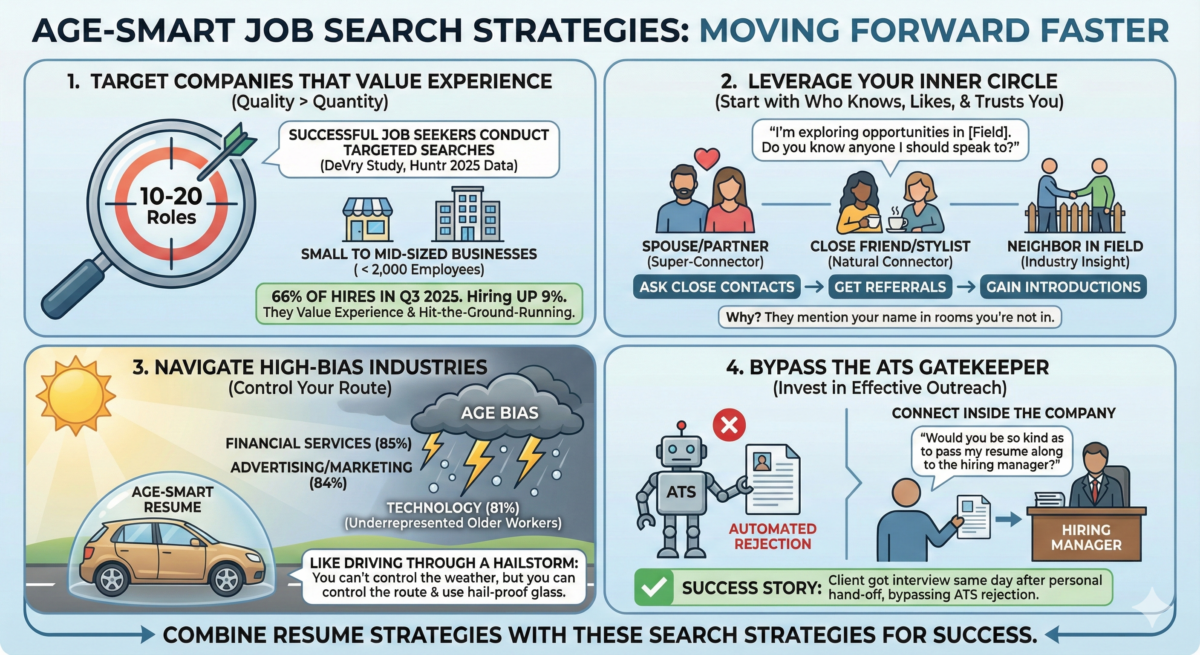
A Devry University Career study found that successful job seekers conduct a targeted job search. They apply to fewer roles and are very specific about which companies they apply to often applying to 10 or fewer roles. This is backed up by data from Huntr’s job search trends reports for 2025 showing most job seekers this year applied to 10-20 roles before getting an offer.
So, how do you find the companies that will value your experience?
You ask those closest to you. Talk to your friends and family and those in your social circle. “I’m exploring opportunities in (position/industry). I help companies do (plain language). Do you know anyone who might I should speak to?”
Why do you start with your social circle and those closest to you? Two reasons. First, I’ve found over 17 years of coaching thousands of job seekers that when we think about job search conversations (aka networking a word I love to hate) our minds go first to our professional connections and strangers. I want you to pause that inclination and first reach out to chat with the people who already know, like, and trust you. People you’re comfortable sharing your life with.
If I was job searching the first person I’d share that with is my spouse. He’s a super-extrover, natural connector, and literally knows everyone. He’d bring my name up in rooms I’m not in and he’d know who I’d need to meet.
My second ask would be one of my good friends who’s been my hair stylist for a decade. She’s also a natural connector and knows everyone. We’re friends, go to book club together, and church together. If I needed an introduction she’d be the first person to know who I’d need to meet.
Next, I’d reach out to a neighbor already working in the field I’m considering transitioning to (this is hypothetical because I’ve always said if I didn’t do what I do now, I’d teach. The Lord made me a teacher, what can I say). I’d send her a text that would say something like,
“I’m thinking about making a career change into teaching, and I was wondering if you had any advice and would be willing to share what a typical day is like, so I know if I’m heading in the right direction. I’d really appreciate 5-10 minutes of your time.”
Chances are extremely good that conversation would lead to an offer for a referral and the two previous conversations would lead to an introduction.
I’d also ask my closest connections what companies I should target. I bet they know of some small to mid-sized businesses that you haven’t considered.
Which leads me to another point about job search strategy. Have you considered small to mid-sized companies with less than 2,000 employees?
If not, you should. Right now their hiring is up 9% over this time last year. They made up 66% of hires in Q3 of 2025, and they also represent 99% of all businesses in the US. If you’re not including them in your job search you’re ignoring where the majority of hiring is happening right now.
We know that small businesses value experience because they often don’t have the large corporate budgets to invest time training less experienced employees. They greatly value someone with experience who can hit the ground running.
Target industries with lower instances of age bias
Since we know that the “overqualified” label can often be coded language for age bias, if you’re a mature worker, you may want to consider the industry you’re targeting.
Several research studies identify Financial Services (85%), Advertising/Marketing (84%), and Technology (81%) as the sectors where the highest percentage of professionals report age discrimination.
In the tech sector specifically, older workers are underrepresented, with the workforce skewing significantly toward the 25–39 age demographic.
Navigating these high-bias industries is like driving a car through a hailstorm. You cannot control the weather (the industry bias), but you can control the route (which companies/industries you target) and whether you’re using hail-proof glass (age-smart resume strategies).
Invest your time and effort on the most effective strategies
When possible bypass ATS and reach out to a connection inside the company.
If you know someone inside the company a simple request like, “Would you be so kind as to pass my resume along to the hiring manager?” Could get your resume in front of the right person.
I had a client in her 50s who customized her resume, met all the qualifications, and applied online. By 6:15am the next morning she had an automated rejection email in her inbox. She reached out to her connection inside the company and made the request I shared above. He passed her resume along immediately and by that afternoon she had an interview scheduled.
Application systems are not fool-proof. They are stringent gate keepers and many times will weed out perfectly qualified applicants. Whenever possible, get someone to personally pass your resume along to the hiring manager or decision-maker.
I shared this strategy above, but it’s worth mentioning again, lean on the natural connectors in your life for introductions, referrals, what companies should be on your list, and for listening out for you and mentioning your name in rooms you’re not in.
Referrals are by far the most effective way to land your next job. The data from numerous resources proves you are 5-10X more likely to get the interview AND the offer if you have an employee referral.
This one strategy will multiple your job search efforts exponentially. If I had to choose between investing 3 hours a week into gaining referrals in my job search or applying online I’d work on the referrals. You’ll 10X your results (more interviews and offers) by working on getting a referral.
FAQ’s: How to Overcome Being Overqualified
How to respond to being overqualified for a job?
You want to reframe being overqualified (and proactively address it if you suspect that they may perceive you as being overqualified – like if you’re downshifting or taking a step back in your career). Here’s one of my favorite ways to bring this up in conversation:
“You might be wondering why someone with my background/experience/credentials wants this role. What excites me about this role is…”
Then fill in the blank honestly and authentically about what this role lets you do that you’re excited about. You’ll address their unspoken worries and overcome the overqualified objection. They’ll see your experience as an asset rather than a risk or liability.
How to address being overqualified in an interview?
It’s important that you’re proactively overcoming their objections, especially those around flight risk, salary expectations, and having a younger manager. Share where you’re at in your career, why this position is important and why now. If you’re not looking for the same pay you can address that, too.
Why do jobs reject you for being overqualified?
Companies reject candidates for being “overqualified” for three main reasons:
- They’re worried that you’ll be a flight risk and leave when something better comes along.
- They’re worried you’ll want more money than they can afford to pay you.
- They don’t think you’ll like working for a younger manager.
- It’s coded language for age bias.
How to get hired if you’re overqualified?
To get hired in spite of being overqualified you’ll need to rely on connections and relationships as your primary job search method, especially if you’re hearing the phrase “You’re overqualified” a lot in your job search. Secondly, you want to make sure you’re proactively addressing the employer’s fears at every possible opporunity (in your cover letter and interview).
How to respond to you’re overqualified?
If at all possible address this proactively by sharing why you’re specifically interested in the company and role. One of my favorite reframes is to say, “You might be wondering why someone with my years of experience is interested in this role. Then tell them truthfully what excited you about the role.
Phew, when I set out to teach you how to overcome the overqualified label I didn’t intend to do such a deep dive on the topic but I’d be remiss if I didn’t teach you the strategies I know work from the data and from coaching thousands of job seekers. Now, it’s your job to take these tips and to put them into action. Having the knowledge is only half the battle. To be successful, you have to do something with it.
Don’t let the ‘overqualified’ bias stall your career. You don’t just need a document; you need a strategy to get your foot in the back door.
Want your resume to show them your value?
Tired of the ‘overqualified’ label blocking your path? It’s time to change the conversation. Get the Age-Smart Resume Playbook and turn your seniority into your selling point.
Share this post:




About the author
Jessica Hernandez, President, CEO & Founder of Great Resumes Fast
Hi, I’m Jessica. I started this company back in 2008 after more than a decade directing hiring practices at Fortune 500 companies.
What started as a side hustle (before that was even a word!) helping friends of friends with their resumes has now grown into a company that serves hundreds of happy clients a year. But the personal touch? I’ve kept that.
You might have seen me featured as a resume expert in publications like Forbes, Fast Company, and Fortune. And in 2020, I was honored to be named as a LinkedIn Top Voice of the year!
I’m so glad you’re here, and I can’t wait to help you find your next perfect-fit position!
1 Comment
Leave a Comment
Improve Your Resume: Download Your Free Executive Resume Template Today
Are you struggling to create an executive resume that will impress employers? Download this free executive resume template and receive a series of 10 emails with expert guidance on how to write resume content that resonates with employers so you get more interviews.
It's everything you need to stand out, make an impression, and accelerate your job search.
Work with Us




Excellent. I am also facing this Problem, instead of having Skill and brilliant interview session, ultimately I am not gating the Appointment Letter. Actually after Woking 15 yrs on Engineering and Management Skill, in the year 2019 Oct I joined in IT Sector and got all the exposure and required Skill set in DS, zML, AI and Gen AI by working in a Start up Company. The reason for shift of Carrier is due to tremendous passion for cutting age technology like AI, ML and Gen AI. The most important thing that from the beginning of my Carrier I can abel to understand all the technical aspects of IT, and have innovative power and abel to understand the trends of Market. Apart from that I have tremendous power of adaptability and Collaboration and have capacity to work with Gen Z, give Leadership and accept Leadership from Gen Z. which is the added specialty of my carrier
I love challenge and adaptability , drive me to the IT sector to diversified and utilizing my Past exposure, which is the added advantage to my candidature. Moreover my Advanced Gen AI model will be the Game Changer for IT sector. So need support and appreciation from Tire 1 , IT company. My Skill , Innovative power and Business Intelligence will definitely add vales to my future employer. Only I need an opportunity to work in Tier 1 company