 A Golden Rule Company
10 Resume Writing Tips for 2026 (Beat the AI Filters)
Last Updated on July 23, 2026 by Jessica Hernandez
AI now screens most resumes before a human ever sees them. Here are 10 resume writing tips for 2026 that get you past the bots and into the interview.
I wrote a version of this post back in 2018. Some of that advice still holds. A lot of it doesn’t, because the hiring process it was written for doesn’t fully exist anymore.
57% of hiring managers now use AI to screen resumes and applications, according to Resume.org. And a June 2026 Harvard Business Review analysis of more than 6,000 screening sessions and interviews with 120 talent-acquisition leaders found that generative AI has undermined nearly every traditional hiring signal, from polished resumes to structured interview answers. Your resume isn’t just competing for a recruiter’s six-second glance anymore ~ it’s competing to pass an algorithm’s judgment before a human ever opens the file.
The majority of companies using AI are letting that AI decide who moves to the next round without human input.
It’s not necessarily bad news. It just means the game has changed and how your resume shows up has to adjust too. You’ll need to write not just for AI but for the major different AI systems and for the human eventually reading your resume too.
Below are 10 resume writing tips for 2026, rebuilt from the ground up for how hiring actually works now. Grab a cup of coffee (or sweet tea, if you’re in my neck of the woods) and let’s get into it.
Perhaps you’re one of the thousands of career professionals assessing their career path and considering growth, advancement, or change. Maybe you just want to be prepared for the right opportunity should it present itself this year—either way, your resume is the main tool to get you where you want to go. Whether you’re charting your career path, planning for growth, considering a career change, or haven’t needed a resume in ten-plus years, these resume writing tips are timely advice you need to hear.
What’s Actually Changed: 2018 Advice vs. 2026 Reality
| What 2018 Said | What’s True in 2026 |
|---|---|
| Recruiters scan your resume for six seconds | AI screens your resume before a recruiter ever opens it. HBR’s June 2026 analysis found early-stage hiring is now built around surviving automated filters first, not impressing a human first. |
| Personal branding surveys reveal your unique voice | Named, quantified accomplishments are your real differentiator. AI screeners are learning to favor AI-polished language, so specificity is what proves a human (you) actually wrote it. |
| Templates are the enemy of authenticity | Clean templates are fine for structure. Generic AI phrasing (“results-driven team player”) is the new enemy. 80% of hiring managers say they can spot AI-written resumes “at a glance.” And while AI rewards AI, humans penalize it. Now you have to find the middle ground. No wonder we’re all confused and applications are vanishing into thin air. |
| One well-crafted resume covers most applications | Tailor your language to each posting’s exact phrasing. Nvidia’s chief software architect Jonathan Ross has publicly noted “AI likes to use AI,” meaning recruiting tools can favor resumes built with the same model the recruiter’s software uses. |
| Graphics and pie charts make your resume memorable | Complex graphics, tables, and multi-column layouts get misread by ATS parsers like those built into Workday and Greenhouse. Simple formatting survives the algorithm; color and design help the human who reads what’s left. Use graphics when you’re handing your resume to a human. (Networking) |
| LinkedIn recommendations are a nice bonus | LinkedIn gets cross-referenced automatically against your resume. Any mismatch in dates, titles, or claims raises a flag before you ever get a call. |
Ready to put this into action? I built a free executive resume template that already has this exact structure baked in (target role up top, results where hiring managers actually look, formatting that survives the ATS bots). No guessing required ~ just fill in your version and go.
👉 Grab the Free Executive Resume Template
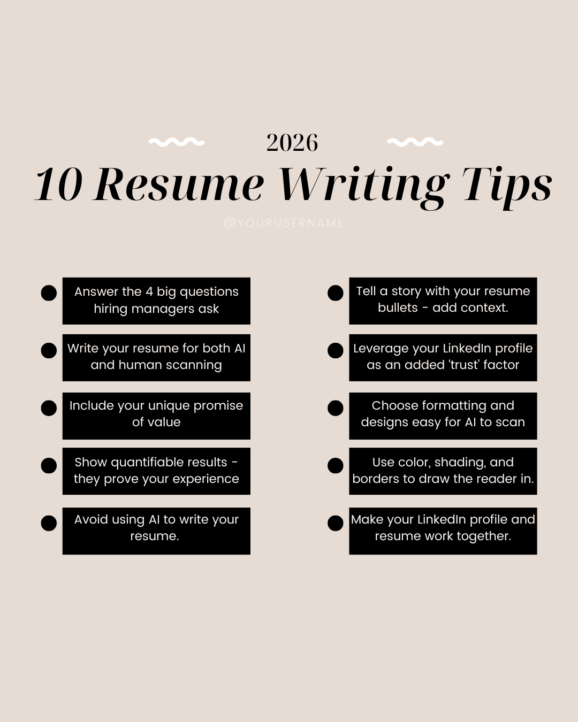
Resume Writing Tips for 2026
1. Give Hiring Managers What They’re Actually Looking For On Your Resume
Hiring managers are scanning the top third of your resume for answers to four specific questions, usually in 15 to 20 seconds. Those questions are:
- What role are you targeting?
- What impact have you made?
- Do you have the right skills?
- Can you deliver in the future?
One of my clients walked into an interview confident their resume told their story well. Five minutes in, the interviewer said, “This resume doesn’t represent you at all… you’re clearly much smarter than this document shows. I almost didn’t interview you.” They made it to round two anyway, but that comment stuck with me, because it’s exactly backward from how it should go. Your resume should be the reason you get the interview, not something you have to overcome once you’re in the room.
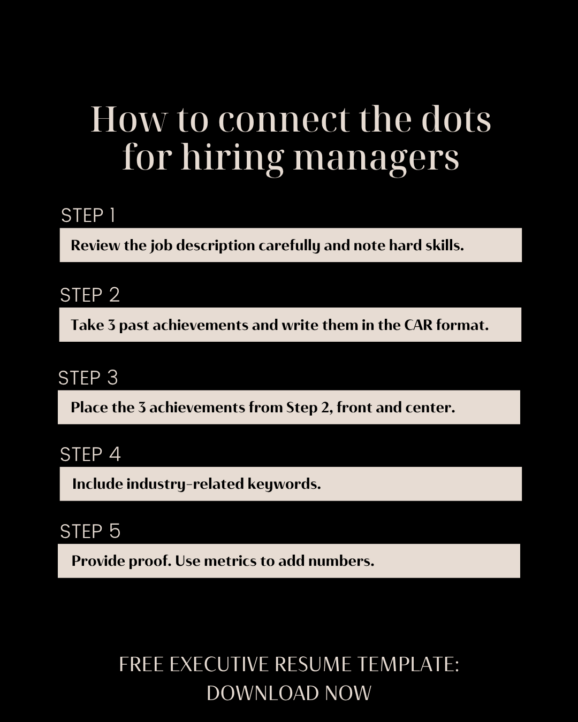
Structure your top third to answer all four questions before a hiring manager has to go looking: target job title at the top, a personal branding statement that couldn’t be said about anyone else, two to three major impact metrics, and your top hard skills.
Connect the dots for them. They will not connect the dots for you.
If you’re navigating this alongside age-based bias, this same differentiation strategy is central to overcoming ageism in a job search. Check out my article: Combating Ageism In Your Job Search.
2. Write a Resume That Works for Both AI and Humans
Mirror the job posting’s exact language for the parsing software, then write substance for the human who reads what survives. Your resume now has two audiences reading it in sequence, not one, and each one is looking for something different.
SHRM’s State of AI in HR 2026 report (SHRM 2026) HR research found that 87% of CHROs now expect AI to be further integrated into hiring workflows this year, up from 83% just twelve months earlier. That shift is why “creative” resumes are riskier than they used to be. Vague titles, unusual section headers (“My Journey” instead of “Experience”), and unconventional formatting confuse parsing tools built by vendors like Workday, iCIMS, and Greenhouse, and a confused parser often means an auto-rejection before a person ever sees your name.
Practical move: pull three to five exact phrases straight from the job posting (not synonyms) and work them naturally into your summary and bullet points. Save the creative language for your LinkedIn About section and your interview, where a human is actually reading it in real time.
I also recommend running the job posting through ChatGPT, Perplexity, and Claude to ask it to pull the main hard skill keywords from the job posting. Then have it look at your resume and recommend where those might naturally work in.
3. Include Your Unique Promise of Value
Your unique promise of value is the specific, provable track record that a generic candidate in your field couldn’t also claim. AI can write generic, keyword-matched bullet points for almost anyone. It cannot replicate your specific relationships, your specific results, or the exact way you solved one particular problem for one particular employer.
This is more true now than it was in 2018, not less. A recent academic study cited by Inc.com reporting on AI resume screening bias found candidates using the same AI model as the recruiter’s screening tool were 23 to 60% more likely to make the shortlist, regardless of qualifications. That’s a system rewarding sameness.
So now, we have this unique situation where your resume needs to be optimized by a couple of the big-name AIs but not fully written by them because when you get to the human screening, recruiters/HR are rejecting AI-sounding resumes. AI in the hiring process is starting to be its own worst enemy (not to mention the worst enemy of every job seeker out there right now). It’s seriously making the case for me that the human connection (conversations that lead to referrals, interviews, and offers) is going to take over as the #1 way hiring will happen. That’s a whole other topic in and of itself. If you want to dive down that rabbit hole, I recommend my article The Hidden Job Market – What It Is and How to Use It.
To figure out and include your unique promise of value on your resume, ask yourself:
- What have I delivered that others in my role couldn’t?
- What do former managers or clients say about working with me, in their own words?
- What’s the throughline across my last three roles?
- Pull actual language from your LinkedIn recommendations and old performance reviews. Repeated words there are your brand, whether you’ve named it yet or not.
4. Show Quantifiable Results on Your Resume
Every bullet point should answer “so what happened” with a number, a percentage, or a dollar figure. Numbers are the one thing an algorithm and a hiring manager both trust immediately, with no persuasion required on your part, because a number is verifiable in a way an adjective never is.
87% of job seekers get this wrong, because they assume that if they didn’t generate revenue directly, they have no numbers to offer. But there are at least eight ways to quantify a resume bullet beyond revenue: size, time, scale, frequency, volume, quality, complexity, and resources.
Compare “managed a team” to “directed a 15-person team across 3 departments in 2 locations.” Compare “improved processes” to “streamlined reporting from 5 hours to 30 minutes, saving 18 hours monthly.” The second version in each pair is the one that gets remembered.
I worked with a property manager named Susan whose resume used to read like a task list. Once we rebuilt it around results (16 interviews and 15 offers in 30 days followed), the phone started ringing differently. For a deeper walkthrough of turning duties into results-focused bullets, this is worth the extra ten minutes.
5. Avoid Sounding Like AI Wrote My Resume
Cut phrases like “spearheaded,” “leveraged,” and “robust,” because hiring managers now actively watch for them as AI tells. One recent 2026 hiring survey found 80% of hiring managers say they can identify AI-written resumes “at a glance,” and that instinct is only getting sharper as more of them read hundreds of applications a week.
Here’s the deeper irony HBR’s June 2026 report surfaced: generative AI has made it “infinitely scalable and practically free” to perform well on paper, whether or not the underlying competence is actually there. That means the gap between a polished-sounding resume and a true one is closing, at least on the surface. What’s left to differentiate you is your voice, specificity, and context. The details only you would know, and that cannot be made up by AI.
Use AI for research, for keyword identification, for analysis, to edit, fix grammar, or check formatting if that helps you. But never let it invent or generalize your accomplishments. Your specifics are the one thing it can’t fake convincingly, no matter how good the model gets.
It’s very similar to Google’s E-E-A-T framework for identifying credible and trustworthy content for SEO and GEO. In each piece of content it looks for the expertise, experience, authority and trustworthiness of the contet. Your resume needs to contain your unique experience, expertise, authority and trust signals ~ and sound like you wrote it, not ChatGPT.
6. Tell a Story With Your Resume Bullet Points
Show the problem, the action you took, and the measurable result, all in one bullet, not three separate thoughts. This is the piece employers and algorithms are both starting to reward: context, not just an outcome floating with nothing attached to it.
PROBLEM: Sales team had lost 15 major accounts to mismanagement.
ACTION: Rebuilt trust with three multimillion-dollar clients personally, through weekly check-ins and a revised service-recovery plan.
RESULT: $3M in recovered revenue growth within two quarters.
Recovered $3M in revenue growth within two quarters. Rebuilt trust with 3 multimillion-dollar clients through weekly check-ins and revised service-recovery plan.
If you wanted to take it up a notch you could even name the specific clients, the industry, or include more context on the before/after issue.
It reads like a story because it is one, and stories are what a human remembers after the resume gets set down, long after the exact percentage has been forgotten. It’s also the format that survives an AI summary of your resume intact, since the cause-and-effect relationship is built into the sentence itself instead of scattered across three bullets.
7. Leverage Your LinkedIn Profile to Prove Your Resume Is True
Recruiters cross-reference candidates online almost automatically now, so a thin LinkedIn profile undercuts a strong resume every time. Your resume makes a claim. Your LinkedIn profile is where that claim gets checked, often before anyone picks up the phone to call you.
In fact, more recruiters are turning to LinkedIn to cross check resumes because the generally held belief is that while people may unintentionally (or intentionally) falsify information on their resumes, they’re less likely to do so on a public-facing profile. This is another reason to fact-check ANYTHING AI writes for your resume. Or, avoid the issue altogether by not having AI write it.
Request recommendations that speak to specific accomplishments, not just character; a recommendation that says “increased regional sales 22% in her first year” carries more weight than “great to work with.” Especially when those specifics back up your unique promise of value and what a future employer for your target role would value. Keep your skills section current so the right ones surface in recruiter searches. Make sure your headline says what you actually do, not just your job title copied from your offer letter.
Pro tip: if you get a great recommendation, take a snippet of it and include it as a quote on your resume either near the role in the experience section or if it’s a really big WOW statement in the top third of your resume. It provides social proof and almost acts like a referral.
I rebuilt my husband’s LinkedIn profile around this exact principle: specific results up top, headline rewritten around outcomes instead of title, skills section pruned to what actually mattered for his target roles. His profile views jumped 8,500% with recruiter outreach starting within 48 hours. He had a job offer in 19 days. It’s worth knowing exactly what a recruiter sees the moment you hit apply, too, since your resume and profile are being read side by side in that window.
8. Format Your Resume So It Scans Correctly
Use a single column, standard fonts, and no graphics, tables, or text boxes that confuse a parser. The old “6-second scan” statistic came from TheLadders’ 2018 eye-tracking study, and newer research (along with what I’m seeing firsthand with clients) shows recruiters now spend closer to 15 to 30 seconds on an initial human pass, depending on volume and role, once a resume has already cleared the automated gate.
Roughly 80% of that human attention still lands on the top third of the page: name, title, company, dates. But that human pass only happens after ATS platforms like Workday, iCIMS, or Greenhouse have parsed your document correctly in the first place. Save visual creativity for a personal website or portfolio, not the .docx or PDF that has to survive a parsing pass first.
9. Use Color and Design on Your Resume in 2026 to Stand Out
Yes, but only after your formatting is confirmed ATS-safe, since design is now secondary to function, not primary. Subtle, professional color still helps a human reviewer’s eye land where you want it, once you’ve survived the parsing stage that happens before any person opens the file.
A beautifully designed resume that an ATS can’t read correctly never reaches the human who’d appreciate the design in the first place; the pie charts and skill graphics that felt cutting-edge in 2018 are now liabilities more often than assets. If you want personality in your presentation, put it in your cover letter voice, your LinkedIn banner, or your portfolio site instead, where a human is guaranteed to be the one looking.
Lean on color, bolding, shading, and borders/border boxes to draw attention to content you want the hiring manager to see. These elements can break up larger sections of text and direct they eye where you want it. I created a free executive resume template that takes care of the formatting and design piece for you. It also includes content prompts for each section so you know what to include and where. You can grab it here.
10. Make Your Resume and LinkedIn Profile Work Together
Your resume, LinkedIn profile, cover letter, and outreach messages all need to say the same thing about you. A hiring manager is now piecing together your whole digital footprint before they ever call you, not reading one document in isolation the way they might have in 2018.
If your resume says “strategic operator” and your LinkedIn says nothing about strategy, that gap costs you credibility, and in a hiring environment where MeetGinger cofounders Shraddha Sunil and Mudit Saraf told HBR that even interview performance is becoming “scalable and practically free” to fake, consistency is one of the few signals left that’s hard to manufacture. If you want your LinkedIn presence itself doing more of the work to attract recruiters instead of just backing up your resume, that’s a specific skill worth building on its own. Consistency across your career materials isn’t polish. It’s the whole point.
FAQs: Resume Writing Tips for 2026
Q: Do I need to write my resume differently because of AI screening? A: Yes, somewhat. Mirror the job posting’s exact language for parsing accuracy, but keep your accomplishments and voice human. AI-flavored phrasing is now a red flag hiring managers actively watch for.
Q: What’s the single biggest resume mistake in 2026? A: Listing duties instead of quantified results. Hiring managers scan the top third of a resume in 15 to 20 seconds looking for proof of impact, not a list of what you were responsible for.
Q: Should I use AI tools to write my resume? A: Use AI for structure, formatting, and keyword alignment. Never let it generate your accomplishments. Specific, verifiable results are the one thing AI can’t fabricate convincingly, and hiring managers are trained to notice when it tries.
Q: How long do hiring managers actually spend looking at a resume now? A: Roughly 15 to 20 seconds on the initial human pass, per practitioner data and multiple 2026 studies, and that’s only after your resume has already cleared automated screening.
Q: Is it still worth using color or design on a resume? A: Yes, but only after your formatting is ATS-safe. Subtle color and clean layout help a human reviewer once you’ve survived parsing. Complex graphics or tables can get you misread or filtered out entirely.
If your resume has ever undersold you, this is your chance to fix that. You just need a resume that finally says what you’re capable of. I made this free template to make that part easy (target role, impact, skills, proof, all mapped out for you). Download it, spend fifteen minutes filling in your version, and let’s get you in front of the right people.
Share this post:


About the author
Jessica Hernandez, President, CEO & Founder of Great Resumes Fast
Hi, I’m Jessica. I started this company back in 2008 after more than a decade directing hiring practices at Fortune 500 companies.
What started as a side hustle (before that was even a word!) helping friends of friends with their resumes has now grown into a company that serves hundreds of happy clients a year. But the personal touch? I’ve kept that.
You might have seen me featured as a resume expert in publications like Forbes, Fast Company, and Fortune. And in 2020, I was honored to be named as a LinkedIn Top Voice of the year!
I’m so glad you’re here, and I can’t wait to help you find your next perfect-fit position!
20 Comments
Leave a Comment
Improve Your Resume: Download Your Free Executive Resume Template Today
Are you struggling to create an executive resume that will impress employers? Download this free executive resume template and receive a series of 10 emails with expert guidance on how to write resume content that resonates with employers so you get more interviews.
It's everything you need to stand out, make an impression, and accelerate your job search.
Work with Us




gta online money generator legit
10 Resume Writing Tips for 2018
baby Gates Sale canada
10 Resume Writing Tips for 2018
Powerful marketing tool
10 Resume Writing Tips for 2018
Thank you Jessica! When I went searching for tips to help me refresh my resume, THIS ended my search. Your article was refreshing and provided great advice for clarifying what I want next in my career.
[…] Whether you’re charting your career path or haven’t needed a resume in ten-plus years, these resume writing tips for 2018 will help you reach your career goals. […]
❤ https://procv.biz
[…] themselves to work time and time again. Great Resumes Fast recently published an article on the best resume writing tips for 2018 — these sound principles hold true regardless of whether you’re trying to land your very first […]
Do you write resumes? How do I find a job without my work figuring out that I am looking?
Thank you
Hi Janine, I do write resumes. I’d strongly recommend job searching confidentially. The number one way to do this is to turn on the Open Candidate Feature on LinkedIn. It lets recruiters know that you’re searching but not your current employer.
Hi Jessica,
I sent an e-mail to your info address but it may be in a spam filter. Your services seem exactly what I’m looking for so I’m wanting to get further information.
Cheers to you
After reading this article with these pointers and why Jessica listed these pointers, I am very impressed – and I didn’t just fall off a turnip truc
k as they used to say.
Count me in for her services.
Your resume is “”you”” made in words, therefore, it should accurately and tactfully describes you as a professional. This document should make the hiring managers interested to see you in person and know more about your qualifications. In crafting your resume, always make sure that the words you use resonate with the requirements of the job. This is because no matter how good you are, if it does not fit the demand, your resume will be thrown away. The way you state your skills, achievements, and work experiences should mirror the details of the role you are applying for. Replace your objective section with a career summary. For elaboration on this, you may visit these links: https://www.monster.com/career-advice/article/how-to-write-first-resume-0518, https://www.asme.org/career-education/articles/job-hunting/6-tips-for-writing-an-effective-resume.
You may forget to give importance to the way your resume will look by focusing too much on the details. Readability is very important. No matter how convincing your accomplishments are, if your document did not get read, it’s useless. The font styles that you use affect the readability. I can’t describe it here in my comment because I want you to be able to visualize this stuff by checking this good article: https://www.infotechresume.com/font-styles-in-resume-writing/. I hope this would help you.
[…] for the company. Jessica Hernandez, Executive Resume Writer for Great Resumes Fast, compiled a thought-provoking list of questions that you may want to consider while looking for those things that make you […]
[…] for the company. Jessica Hernandez, Executive Resume Writer for Great Resumes Fast, compiled a thought-provoking list of questions that you may want to consider while looking for those things that make you […]
Great tips! What I learnt from my previous boss, which is similar to one of your advice, is to build a resume that has a narrative (story). It makes it easier to communicate/sell your self and you skills to potential employers, letting them know how you have become the person you are now and why you are the perfect fit for the position you are trying to apply for.
Quick question though, when you say stay away from templates, what is you thoughts on following online resume samples such as the ones listed here https://www.super-resume.com/resume-examples as a guide? Websites like this often highlight that their samples have been proven to work for big companies (Apple, Google, etc). Is it worth using their tools and samples?
Can you take a look at my resume plz?
Hi,
Take the resume writing tips from maxecv.
The above article is very useful to write a professional resume for the job and the career. Thanks for sharing the article.
what do u recommend if i’m looking for jobs that will involve the employer sponsoring my visa from either canada or new zealand?
Thankyou for sharing this information! If you want to make a professional resume, you can visit Resume Making Service . We provide customized, personalized resume writing service that begins with expert tips and consultation to analyze your accomplishments, social and emotional intelligence, skills, and professional assets as well as resume guides.