 A Golden Rule Company
Why Is Finding a Job So Hard in 2026? (4 Real Reasons)
Last Updated on September 7, 2026 by Jessica Hernandez
If you’ve been job searching for more than a minute, this question has probably crossed your mind. Why is finding a job so hard right now? I wish there was a simple answer, because then maybe there’d be a simple fix.
Unfortunately, it’s a combination of several factors that affect how long your search will take and how long it will be before you hear “We’d like to extend an offer.” I’m tackling the four biggest roadblocks to finding a job in 2026 and the best antidote to each so you can go from searching to hired a heck of a lot faster.
Ghost Jobs Abound: The Unofficial Zombie Job Apocalypse
Actually, the Zombie Jobs reference came from a client of mine when she was describing the unbelievable amount of ghost jobs she’d applied to. So no, you’re not imagining it; there has been a rise in ghost jobs.
Hiring platform Greenhouse’s data show that roughly 1 in 5 jobs is a ghost job ~ meaning companies made postings with no intent to hire.
It’s not going unnoticed either; Bankrate Senior Economic Analyst Mark Hamrick noted in June 2026 that the spike in job openings was “almost entirely driven by a single sector (professional and business services)” and that there’s a “distinct disconnect” between positions being posted and actual hiring activity.
A client shared this with me recently: “My biggest frustration is fake job postings. I often see the same job ads posted for months, which makes me wonder if the roles are real or if companies are struggling to commit to hiring.”
Part of the issue is that they’re not committed to hiring or they’re pulling back on hiring mid-search. The other issue is that recruiters are posting jobs to fill their pipeline, see what’s on the market, test a job posting, gather intelligence on competitors (via which companies have people ready/willing to move), and a host of other similar scenarios.
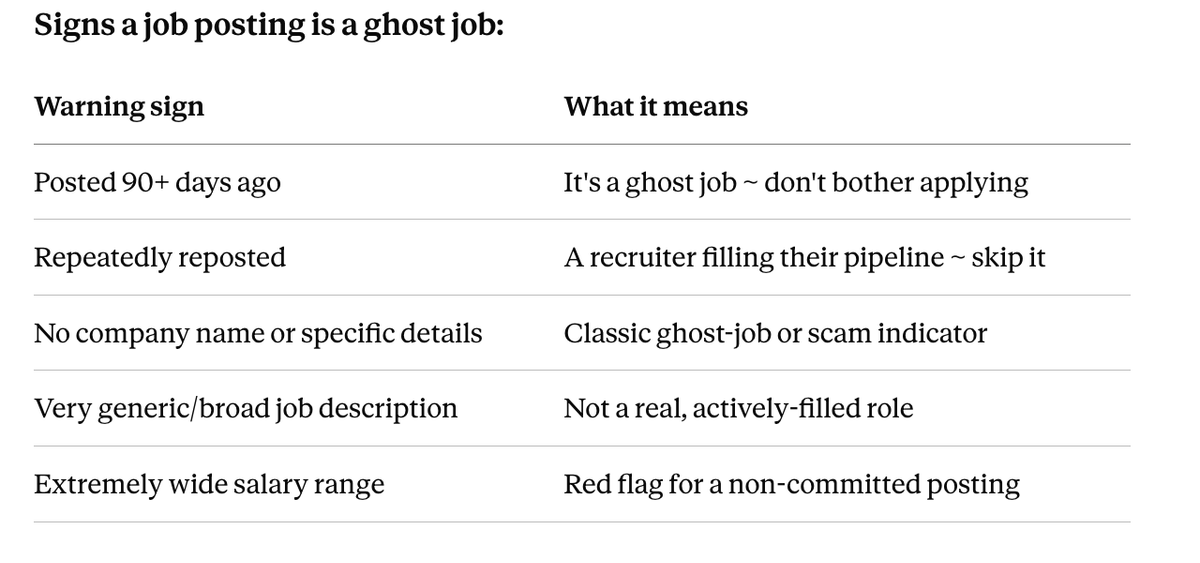
There are a couple ways to combat this. I’ve given you the two best antidotes I know:
Antidote #1: If you see a job that’s 90+ days old, don’t bother applying. It’s a ghost job. If it’s repeatedly being posted/reposted, it’s a recruiter trying to fill their pipeline; you can ignore that post. Additionally, if there’s no company name or specific details, the job description is very generic/broad, or the salary range is extremely wide, these are all indications of ghost job postings not meant to be filled (or scams). You can skip applying to these with no fear of missing out on a great role.
Antidote #2: Conversations with people you know, like, and trust. Who do you know that is in your industry, role, or who knows someone (maybe their spouse or friend) who is in your industry? I’ve been shouting this from the rooftop for the last year: the human connection ~ conversations and referrals ~ are how hiring is going to happen. According to Erin, an Employee Referral Software Company, 1 in 3 companies has now turned to referrals to cut down on bloated applicant pools.
LinkedIn reports that you are 3X more likely to be hired by a company if you’re already connected with an employee before applying, and in this news article, the executive director of the London Business School’s Career Centre, Zoe McLoughlin, stated, “Networking has always been important. It’s now absolutely crucial. If it’s a job you really want, at least one person at the company needs to know your name before you apply.”
If you’re not sure how to start conversations about your job search, that’s exactly what I help you with in my free 7 Networking Scripts pack (designed for people like me who hate asking for help and dread small talk with strangers). I give you the exact words to start conversations with people that naturally lead to referrals, interviews, and job offers.
What Is a No-Hire/No-Fire Job Market?
The job market is in this weird place where people who are currently employed are relatively safe, but those searching are having a harder time because people aren’t moving and companies aren’t hiring or firing. That makes unemployment look steady, but even that is changing.
Economists are warning that with all the WARN notices being filed by big companies like Amazon, Walmart, FedEx, etc., it’s actually looking like a low-hire, higher-fire market.
The imbalance between job openings and job seekers is widening, and that can make it feel like a recession. Especially depending on where you live ~ for instance, in the Southeast and California, the market is slack (lots of employees and companies get their pick of the best), but in the Northeast and Midwest it’s tight (fewer employees, aging workforce, skills mismatch). How it feels to you as a job seeker can vary depending on where you live, your industry, and the local market.
I suspect with all the WARN notices piling up, we’re heading into a Fall that’s not going to feel great if you’re a job seeker. I’m also skeptical about people feeling relatively safe in their current roles.
Yesterday I went to Aldi to buy groceries, and the cashier was scanning my items very quickly. He looked frazzled. I said, “Wow, you deserve an award for how fast you’re scanning everything!” He replied, “They track how fast we’re scanning, and if we don’t meet their requirements, we’re out of a job.” He was genuinely worried. I left the store thinking I’d just gotten a first-hand view of exactly how some job seekers are feeling about their job security right now. My heart went out to him.
So what options are there in a no-hire, no-fire job market? How do you work with what you’re up against?
The Antidote: Start by asking where hiring is happening. Look at the data ~ I like looking at Indeed’s Hiring Lab, ADP’s National Employment Report, and the BLS. I actually broke down exactly what to do instead of the usual apply-and-wait cycle here: Why Isn’t Applying to Jobs Online Working Anymore?
Then, start conversations where hiring is happening. I dive deeper into who is hiring, where hiring is happening, and what methods work best inside my Rapid Response Job Search Techniques course.
Where Is the Best Place to Job Search Right Now?
The best place to job search right now is not where everyone else is searching. Where is everyone else searching? LinkedIn Jobs Tab and Indeed. Huntr’s 2026 Q1 & Q2 reports show that LinkedIn receives about 158X as many applications as any other site. They actually receive more applications than every other site combined.
And most job seekers use only the Jobs tab on LinkedIn to search for and apply for jobs. They’re not using the 50+ other tools, features, and best practices that can actually attract offers to them. It’s a weird mismatch of everyone huddled together trying to go after the same 5 jobs instead of spreading out and diversifying their efforts.
It reminds me of my 10U soccer team. At the start of the season, all the kids like to bunch together to go after the one ball. But, if you’re a soccer fan, you know that’s not how the pros play. They spread out. So we asked the kids, “When you eat pizza, do you like all your pepperoni stacked in one spot on the pizza or do you like it spread out all across the pizza?”
Of course the kids said spread out (except the one team clown. He said all in one pile). They got the picture, and after that they learned to stay on their side of the field and be open for the pass and to make the run.
Well, right now, job seekers are like my beginner 10U soccer players, all huddled around one ball (LinkedIn Jobs Tab), trying to get to it. But because so many people are crowding it at once, no one can get anywhere. The moral of the story is you have to diversify your search.
The LinkedIn Jobs tab is not the only place to find a job. And I want to be very specific about that ~ because LinkedIn is a great place to find a job and there’s more than one way to use LinkedIn to get interviews and offers.
Karen, a Communications Executive, used the strategies I teach inside my LinkedIn Unlocked course to create content and leave comments that put her in front of the right audience. She landed three offers without applying to a single job posting on LinkedIn.
Another client, Manley, a Sr. Technology Program Manager, used the strategies I teach in LinkedIn Unlocked to attract recruiters to his profile and secure interviews and an offer.
There’s more than one way to use LinkedIn to get interviews and offers. There are also more places to search for jobs than on LinkedIn.
The Antidote: Be like pepperoni on a pizza. Spread out/diversify your search methods and sites. Don’t rely on the LinkedIn Jobs Tab and Indeed alone.
Why Is the Over-Optimized, AI-Perfect Resume Backfiring?
54% of small businesses report hiring challenges because they can’t tell who is actually qualified by reviewing resumes anymore.
I started seeing a trend in the data over the past couple of months where recruiters and companies were saying they couldn’t tell candidates apart anymore because so many were using AI to optimize their resumes and each document sounded the same.
Now, we’ve progressed into full-blown alarm bells. Hiring managers, companies, small businesses ~ they’re all saying the same thing. 77% believe many resumes they see now look AI-generated, and it’s eroded trust. So much so that now they’re leaning into more validation in interviews, assessments, AI interviews, work projects, or work trials ~ all in an attempt to find evidence or proof that candidates have the experience their resumes state they do.
This is because they review a resume and make a hire based on the experience the person stated they have on their resume but once the person starts the job the company finds out they’re really not as qualified as their resume made them out to be. And now the “resume honor system” that’s worked for decades is gone. Trust and credibility has been eroded.
I definitely understand the unfair standard. Companies can use AI in the hiring process, but candidates are penalized for doing so? If you’re thinking it’s unfair, you’re right.
However, the use of AI has completely changed how hiring is accomplished. That we know for sure. It’s made it virtually impossible to tell candidates apart on paper. Polish alone is no longer a differentiator. Your resume is no longer proof enough you’re qualified.
Not sure your resume is even in the right shape to compete right now? Start with this free executive resume template; it’s the foundation I’d hand you if we were sitting across from each other.
You’ll need to provide further proof points to be considered a qualified candidate and get the interview. So what’s the fix for advancements in technology that have fundamentally altered how we search?
The Antidote: Human touch. Write your documents in your human voice. Rely on referrals and networking. Back it up with proof on your LinkedIn profile.
FAQs: Job Searching in 2026
Q: Why is finding a job so hard in 2026? A: Four factors are colliding: roughly 1 in 5 postings are ghost jobs (Greenhouse), the market is low-hire/higher-fire, most seekers crowd onto LinkedIn Jobs Tab and Indeed, and AI-polished resumes have eroded hiring managers’ trust in what candidates claim.
Q: What is a ghost job? A: A ghost job is a posting a company makes with no real intent to hire ~ often to build a talent pipeline, gather competitive intelligence, or test the market. Greenhouse data shows about 1 in 5 job postings fall into this category.
Q: How do I know if a job posting is a ghost job? A: Watch for postings older than 90 days, listings that get reposted repeatedly, missing company names or vague details, generic job descriptions, or unusually wide salary ranges ~ all signs the role likely isn’t real or actively being filled.
Q: Is LinkedIn a good place to find a job in 2026? A: Yes, but not through the Jobs Tab alone ~ Huntr’s 2026 data shows LinkedIn gets roughly 158X the applications of any other site. Using LinkedIn’s content, networking, and profile-optimization features works better than applying through the Jobs Tab.
Q: Should I use AI to write my resume? A: Use AI to structure or edit, but avoid letting it flatten your voice. Hiring managers report resumes increasingly sound identical, which has pushed more companies toward interviews, assessments, and work trials to verify real experience.
Ready to Make Your Job Search a Little Easier?
Start by screening the job postings you’re applying to; look for signs of a ‘ghost’ posting and skip applying to those. Take the time to target companies and industries that ARE hiring, while using the job search sites with the highest response rates. Then, skip the over-optimized AI resume in favor of a human-written resume and start conversations with people you already know.
The first thing you’ll notice is an increase in response rates to your applications. The second thing is that those conversations will lead to referral offers. Third, you’ll notice you’re not feeling as discouraged, and you’ll start getting hours back in your schedule because you’re not hunched over your computer for 8 hours submitting applications every day.
Want to Go Deeper on Strategies to Make Your Search Easier and Faster?
I dive into the data, how to find the right sites, which companies to target, and where hiring is happening inside my Rapid Response Job Search Techniques course. These are the strategies I wish every job seeker had in their arsenal.
Share this post:


About the author
Jessica Hernandez, President, CEO & Founder of Great Resumes Fast
Hi, I’m Jessica. I started this company back in 2008 after more than a decade directing hiring practices at Fortune 500 companies.
What started as a side hustle (before that was even a word!) helping friends of friends with their resumes has now grown into a company that serves hundreds of happy clients a year. But the personal touch? I’ve kept that.
You might have seen me featured as a resume expert in publications like Forbes, Fast Company, and Fortune. And in 2020, I was honored to be named as a LinkedIn Top Voice of the year!
I’m so glad you’re here, and I can’t wait to help you find your next perfect-fit position!
Improve Your Resume: Download Your Free Executive Resume Template Today
Are you struggling to create an executive resume that will impress employers? Download this free executive resume template and receive a series of 10 emails with expert guidance on how to write resume content that resonates with employers so you get more interviews.
It's everything you need to stand out, make an impression, and accelerate your job search.
Work with Us