 A Golden Rule Company
Not Hearing Back From Job Applications? Here’s Why
Last Updated on September 15, 2026 by Jessica Hernandez
Applied to dozens of jobs with no response? Here are 5 real reasons you’re not hearing back from job applications – and what actually works in 2026.
You found a job posting that might as well have had your name on it. Every requirement ~ check. Every preferred qualification ~ double-check.
You spent real time on that application, hit submit, and then it vanished into thin air. POOF
Not even a “thanks, but no thanks.”
If I were sitting with you sharing a cup of coffee in real life, I’d tell you it is not about your qualifications. I know it feels personal, but it’s not.
And the fact that 50% of my 500,000+ subscribers say this is happening to them right now tells me you’re not alone; it’s a systemic problem, and it’s an indication of how much the market has changed. Even in the last year alone.
Even the most qualified candidates are struggling to get responses, and there are legitimate reasons why that have absolutely nothing to do with your ability to do the job.
Here’s what’s actually going on – and more importantly, what you can do about it.
Why Am I Not Hearing Back From Job Applications? (The Short Answer)
You’re not hearing back from job applications because the hiring process itself is busted – not because you’re unqualified. In 2026, the average job board converts applications to hires at only 6%. LinkedIn’s rate is 2.9%. Indeed’s is 3.1%.
That means for every 100 applications submitted on LinkedIn, fewer than 3 result in a hire.
There are five specific reasons this is happening, and none of them are your fault. But knowing them gives you the power to route around them entirely.
Understanding Why Applications Go Unanswered
The frustration you’re feeling is completely valid. You expect that when you meet all the qualifications for a job, you’ll hear something back. The silence is unjustified – and you’re right to feel disappointed by it.
I wish the application process, ATS software, and AI screenings worked consistently and made sense. But they don’t.
Yesterday, a client shared this: “I spent 4 hours tailoring my resume with ChatGPT and your course literally in front of me. The job was for a past employer I left in good standing with, and I had a referral. I received an automated ATS rejection at 6:15 am this Thursday morning. I was crushed. How did this happen? How did my resume fail the test again?”
I kid you not. She met every qualification, tailored her resume, and still got an auto-rejection from the system.
That’s not the only reason job seekers aren’t getting responses. Let’s walk through every obstacle you’re facing every time you click apply.
Reason 1: An ATS Filtered You Out Before a Human Saw Your Resume
An Applicant Tracking System (ATS) – software that automatically screens resumes before a human ever reads them – is the first obstacle between you and an interview. Most mid-to-large companies use ATS platforms like Workday, Greenhouse, or Taleo to filter applications by keyword match, formatting compliance, and file type before a recruiter sees a single name.
That 6:15 a.m. rejection story above? That’s ATS in action. A real person, a referral, four hours of tailoring – and the system still said no before anyone woke up. Screening questions that are part of the application can be set to auto-reject a candidate. If you’re getting an automatic rejection seconds after hitting submit, it’s probably a screening question that didn’t get answered the way the company preset it’s accepted responses.
For example, if I ask you if you have a PMP certification and I set the parameters to auto-reject anyone who answers no, you would get an immediate rejection email after you click submit.
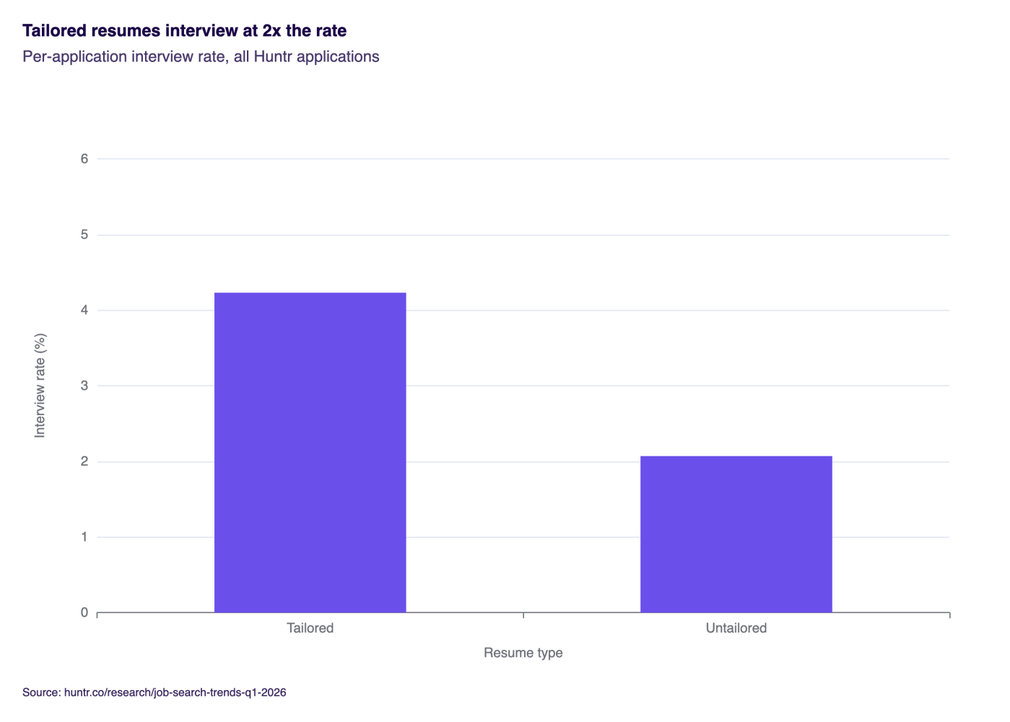
This is one reason why career experts consistently emphasize tailoring your resume to each role. It’s not just a best practice opinion. The data backs it up. Huntr.co‘s Q2 2026 Job Search Trends Report found that customized resumes get a 2.04X higher interview rate than generic ones.
Keyword optimization has its limits, though. Yes, use AI to identify hard-skill keywords in the job description and include them in your resume. But it’s equally important to make sure your resume is telling a strategic story that aligns with the needs of the role – not just checking boxes.
When a resume is keyword-optimized but lacks storytelling and context, that’s a dead giveaway that AI wrote the resume (not to mention the repetitive language patterns). Our brains are wired to see patterns. That’s why when a recruiter reads dozens of resumes per day, it doesn’t take long for them to spot the language patterns inherent in AI use. And since AI is notorious for generic and imaginative content, recruiters are skeptical of AI-written resumes. The same way we’ve become skeptical of AI-written social media posts and articles.
What you can do: Mirror the exact language in the job description – not paraphrased synonyms, but the specific words the employer used. ATS software matches strings, not meaning. Stick to clean formatting: no tables, no graphics, no text boxes. Save as .docx unless the posting specifies otherwise.
- Study the job description for important keywords
- Use clear and simple resume formatting
- Avoid excessive graphics (some are fine once a human is reviewing)
- Align your skills with those the employer emphasized
- Be specific. Specificity is way more convincing than general statements
And here’s the thing – there IS a way to work around an ATS rejection and still get the interview. It involves tapping into referral-based hiring, which converts at 43% compared to 3% on job boards.
Knowing you should reach out to work towards a referral isn’t the problem. Knowing exactly what to say when you sit down to actually write the message? That’s the real one. 🤷 So I did the hard part for you. 7 Networking Scripts for People Who Hate Asking for Help are done, copy-paste ready, and yours free. Grab them here →
Reason 2: You’re Applying to Ghost Jobs That Were Never Meant to Be Filled
A ghost job is a job posting that remains active on job boards even though the company has no current intent to hire for it – or has already filled the role internally. In 2026, ghost jobs are one of the biggest sources of job seeker frustration, and they’re more common than most people realize.
Bankrate Senior Economic Analyst Mark Hamrick noted in June 2026 that the increase in job openings was almost entirely driven by a single sector – professional and business services – with a distinct disconnect between positions being posted and actual hiring activity.
Companies post ghost jobs for several reasons: to build a candidate pipeline for future roles, because a requisition is open but the budget hasn’t been approved, or simply because no one took the posting down after the role was filled internally.
They also post them to make it look like they’re growing when they really aren’t.
What you can do: Before investing time in an application, do a quick LinkedIn search to see if the role has been posted for more than 30 days. If it has, there’s a good chance it’s not actively being filled. Redirect that energy toward the job search activities that are actually producing results in this market.
Reason 3: Your Resume Looks Like Everyone Else’s (Thanks to AI)
Robert Half announced that more than half of small-to-medium businesses reported hiring bottlenecks in 2026 because 90% of incoming resumes look and sound identical – a direct result of job seekers using the same AI tools to “optimize” their applications, according to hiring manager surveys by Resume Now.
When every resume uses the same optimized language, the same bullet structure, and the same keyword density, hiring managers literally cannot tell candidates apart. Instead of speeding up their hiring process, it’s stalling it.
Here’s the counterintuitive truth: a human-written resume that sounds like you – specific, textured, told in your own voice – stands out dramatically right now. Not because AI is bad, but because everyone is using it the same way and the results are blending together into one big beige blob of sameness.
It would be like every candidate choosing the exact same Microsoft Word resume template back in the day. It’s a distinct disadvantage to look and sound the same in a process that rewards standing out.
If you want your resume to actually get read, it needs to be distinctly, unmistakably yours. That’s where working with a professional resume writer – one who writes in your voice, not a template – makes a real difference. (Just make sure you choose one who doesn’t use AI to write it, or you’re right back where you started.)
This is also exactly why understanding what’s actually working better than cold applications right now matters so much in this market.
Reason 4: Recruiters Aren’t Posting Jobs the Way They Used To
Approximately 65% of recruiters have stopped posting jobs entirely and are now sourcing candidates directly on LinkedIn, according to Tom Powner, founder of the NCOPE certification for career coaches – a credential that trains professionals on the behind-the-scenes mechanics of LinkedIn and recruiting.
Why did so many recruiters stop posting? Volume. A recruiter friend of mine said her company had to pull a job posting after just 24 hours because they’d received over 1,000 applications – and could realistically only review the first 100.
So recruiters are skipping the posting step entirely and searching LinkedIn directly for qualified candidates.
What this means for you: Your LinkedIn profile needs to work like a magnet. If it’s incomplete, outdated, or doesn’t use the language recruiters search for, you’re invisible to the very people who are actively looking for someone with your background. Here’s what most job seekers are still getting wrong about LinkedIn – and what to do instead.
Reason 5: The Competition on Job Boards Is Stacked Against You
Fortune 500 companies are the primary posters on LinkedIn and Indeed – and they’re also the ones leading layoffs, filling roles internally, and generating the most ghost postings. If you’re submitting applications on major job boards, you’re competing with thousands of applicants for roles that may not even be actively hiring.
The math here is uncomfortable but important. LinkedIn’s application-to-hire conversion rate is 2.9%. The average across all job boards is 6%. Meanwhile, referral-based hiring converts at 43%. That’s not a typo. Referrals are 14 times more likely to result in a hire than job board applications.
This is the market reality in 2026. It doesn’t mean you can never apply online. It means online applications alone cannot be your strategy.
So What Actually Works? (This Is the Good Part)
The most effective job search strategy in 2026 is tapping into the hidden job market – any job, posted or unposted, filled through relationships and referrals rather than applications.
I know “hidden job market” can sound like there’s some exclusive secret club you weren’t invited to. There isn’t. It simply means that jobs get filled through conversations, and the people having those conversations get the interviews.
The gap between a 43% referral conversion rate and a 2.9% LinkedIn application rate is your opportunity. Read the full breakdown of how the hidden job market works and exactly how to access it here.
The good news is you don’t need to attend awkward networking events or cold-message strangers. You just have to activate the relationships you already have – former colleagues, managers, mentors, clients – and let them know what you’re looking for. When people know, they can connect you. When they don’t, they can’t.
And that’s exactly where the conversations start.
Want the exact words to say? Grab the free scripts.
You don’t have to become an extrovert to access the hidden job market. Not one bit of small talk required. Zip, Zero, Zilch. I wrote 7 Networking Scripts for People Who Hate Asking for Help for exactly this… real messages, zero cringe, ready whenever you are. Come get them →
FAQs: Not Hearing Back From Job Applications
Q: Is it normal not to hear back from job applications? A: Yes – and it’s not a reflection of your qualifications. In 2026, the average job board converts fewer than 6% of applications into hires. Most applications are filtered by ATS software before a recruiter ever reads them. If you’re applying and hearing nothing, you’re experiencing what the majority of job seekers are facing right now.
Q: How long should I wait before following up on a job application? A: One week is a reasonable window for a polite follow-up to the hiring manager or recruiter if you can identify who that is. That said, if the posting is more than 30 days old, it may be a ghost job – a role that’s listed but not actively being filled – and your time is better spent pursuing referral-based opportunities.
Q: Why don’t employers respond to job applications? A: A few reasons: ATS software auto-rejects a large percentage of resumes before a human sees them; many postings are ghost jobs with no active hiring behind them; and the volume of applications – sometimes 1,000+ in 24 hours – makes individual responses impractical. The system is broken in ways that have nothing to do with you.
Q: What’s the best way to get a job when applications aren’t working? A: Shift your energy toward referral-based job searching – also called tapping into the hidden job market. Referral hires convert at 43%, compared to under 3% on LinkedIn. That means telling people in your existing network what you’re looking for, optimizing your LinkedIn profile so recruiters can find you directly, and having real conversations instead of submitting applications into a void.
Q: Does applying to more jobs increase your chances of getting hired? A: Not in the current market. Volume applying on job boards with a 2.9-3.1% conversion rate is a low-return strategy. One targeted referral conversation is statistically more likely to lead to an interview than 50 cold applications. Quality of connection beats quantity of applications every time right now.
When it feels like your efforts vanish into thin air…
The job search silence you’re experiencing is not a sign you’re not good enough. It’s a sign that the old way of searching simply does not work in this market and that you need a different approach.
ATS filters, ghost jobs, AI-identical resumes, recruiters who’ve stopped posting, and impossible competition on job boards have all combined to make cold applications one of the least effective ways to land a job in 2026.
The candidates getting hired are the ones having real conversations. And those conversations don’t have to be complicated or awkward – they just have to happen.
Ready to start the conversation?
That person you’ve been meaning to message for three weeks? Yeah, that one. I made it easy. 7 Networking Scripts for People Who Hate Asking for Help ~ free, done-for-you, no jazz hands required. Download here →
Share this post:

About the author
Jessica Hernandez, President, CEO & Founder of Great Resumes Fast
Hi, I’m Jessica. I started this company back in 2008 after more than a decade directing hiring practices at Fortune 500 companies.
What started as a side hustle (before that was even a word!) helping friends of friends with their resumes has now grown into a company that serves hundreds of happy clients a year. But the personal touch? I’ve kept that.
You might have seen me featured as a resume expert in publications like Forbes, Fast Company, and Fortune. And in 2020, I was honored to be named as a LinkedIn Top Voice of the year!
I’m so glad you’re here, and I can’t wait to help you find your next perfect-fit position!
Improve Your Resume: Download Your Free Executive Resume Template Today
Are you struggling to create an executive resume that will impress employers? Download this free executive resume template and receive a series of 10 emails with expert guidance on how to write resume content that resonates with employers so you get more interviews.
It's everything you need to stand out, make an impression, and accelerate your job search.