 A Golden Rule Company
The Fastest Way to Land A Job in 2026 (Without Applying to 300 Jobs)
Last Updated on August 31, 2026 by Jessica Hernandez
Want to know how to get a job fast in 2026? Real hiring data reveals why most searches stall and the fastest way to land a job that actually works.
If you feel stuck in your job search, you’re not alone, and there’s a good reason you’re feeling that way. I hear “I’m stuck, nothing is working” from job seekers almost every day, and once you look at the data, it’s easy to see why.
The fastest way to land a job in 2026 is to stop competing on the most crowded platform and start using referrals, niche boards, and small- to midsize companies instead. LinkedIn applications convert right around 3%, but referrals get you an interview 10 to 14 times more often. Another important point is that small- to mid-sized firms are hiring, but 49% report receiving 20 or fewer applications per role.
That gap is where you get hired faster. Below, I will walk you through exactly where to search, how to use AI without it costing you the interview, and the specific system my clients have used to go from application to offer in as little as 30 days.
Why “Just Apply to More Jobs” Is Terrible Advice
Applying to more jobs on LinkedIn, Indeed (or other major job board) does not speed up your search, it slows it down, because you are competing against nearly everyone else who is also stuck. LinkedIn now captures the majority of job seeker applications, according to Huntr’s Q1 and Q2 2026 Job Search Trends Report, which found that LinkedIn “captures more applied jobs than every other source combined.”
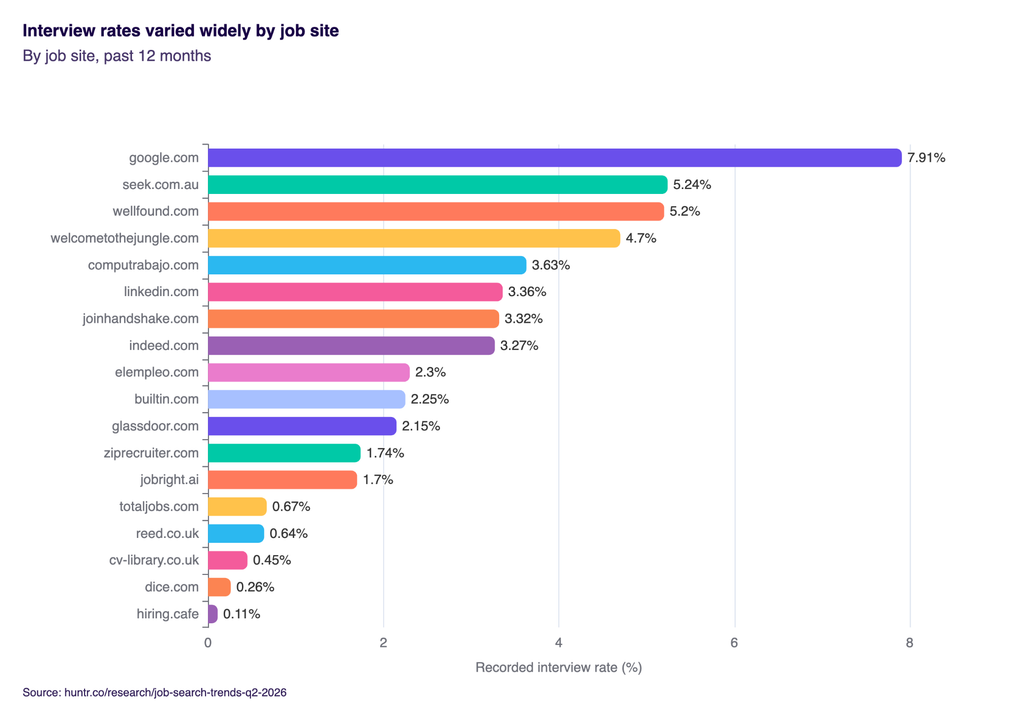
More applicants per job means your resume has to fight harder just to get seen. The same reports found LinkedIn’s per-application interview rate sits at 3%, which converts worse than eight of the seventeen job sites Huntr tracked. Volume is not your friend here.
There are lots of more effective ways to use LinkedIn in your job search. While LinkedIn definitely wins the application volume war, applying is actually one of the least effective ways to leverage LinkedIn in your job search. I cover the best ways to use LinkedIn to job search in my LinkedIn Unlocked course here.
I have dozens of students inside my course who were contacted by recruiters and decision-makers at companies and invited to interview without having applied to a single job. One of my students, Karen, a communications executive, received three interviews and offers without applying to a single role…she got them simply by using the features and optimization strategies I teach in my course.
Another important point – where you apply matters more than how often.
Where Should I Actually Apply? (The Data by Platform)
Google Jobs converts at more than double LinkedIn’s rate, and niche boards beat both. Huntr’s trailing-twelve-month data shows Google.com applications converting at 7.12%, 2.4 times LinkedIn’s 2.94% rate and the highest of any source tracked.
Google Jobs is not a job board. It is an aggregator that pulls listings straight from the company’s own career page, which is exactly why it converts so much higher. It skips the job-board bottleneck entirely.
Wellfound (5.02%), Glassdoor (3.18%), and Indeed (3.14%) all clear LinkedIn’s rate too, according to the same Huntr dataset. Here is how the numbers stack up:
| Platform | Interview Conversion Rate | Applications Tracked |
|---|---|---|
| Google Jobs | 7.12% | 2,064 |
| Wellfound | 5.02% | ~1,700 |
| Glassdoor | 3.18% | 5,866 |
| Indeed | 3.14% | 42,000+ |
| 2.94% | 326,774 |
Action step: Search Google directly for your target role and location, click the “Jobs” tab, and apply through the company’s own career page whenever you can. Inbound applications on company career pages make up more than 40% of hires, according to Ashby, a recruiter platform.
I’d also encourage you to look at niche job boards for your target role, industry, and geographic location. Applicants from niche job boards are rated by employers as higher-quality hires. You are 14 times more likely to land an interview through a niche job board because recruiters view candidates who come through niche boards as specialists, not generalists.
Which companies are hiring?
Small and midsize companies are doing more of the hiring right now, not the Fortune 500 names everyone defaults to because we recognize their name. ADP’s June and July 2026 National Employment Reports found that companies with 2,000 or fewer employees have increased their hiring and added jobs. More than Fortune 500s.
Most job seekers build their target list around the companies with the biggest ad budgets, the Fortune 500 brands you already know by name. Those are also the companies fielding the most applications per opening, which is exactly the crowded-platform problem again, just at the employer level instead of the job-board level.
It’s also important to note who posts jobs to LinkedIn, Indeed, or other major job boards. Mostly Fortune 500s. Which means that the companies doing less hiring are facing more competition because more people are applying via LinkedIn.
When you start adding all these data points up, you start to see why you feel so stuck and like you’re going around a vicious cycle of apply-wait-repeat.
Small to midsize employers are quietly starved for qualified candidates. In healthcare and manufacturing specifically, nearly half of hiring managers report receiving 20 or fewer applications per open role. That is a completely different game than fighting through LinkedIn’s 326,774 tracked applications.
Action step: One of my favorite strategies is to ask Perplexity or ChatGPT to list small and midsize companies in your industry, role, and geographic area, then apply directly to their career pages instead of a job board.
You could also ask Perplexity for a list of niche job boards for your industry, target role, or geographic area.
Is Using AI to Write My Resume Hurting My Job Search?
Yes, if you let it write your stories. AI is fine for research, but it is quietly costing candidates interviews when it writes the content. Insight Global’s AI in Hiring survey found that 99% of hiring managers now use AI at some point in the hiring process, most commonly for screening resumes and pre-screening candidates for interviews.
Here is the catch-22 for job seekers. The same survey found 88% of hiring managers believe they can spot a resume or cover letter written by AI. When every candidate’s bullet points use the same handful of AI-flavored phrases and sentence structures (think “spearheaded,” “leveraged,” “seamlessly”), recruiters stop being able to tell people apart, and that is exactly the opposite of what a resume is supposed to do.
There is also a fairness problem hiding behind the AI-in-hiring statistic: hiring systems built on large language models tend to rank content generated by that same model family more favorably, which creates an impossible catch-22 for job seekers who have no way of knowing which AI tool a given employer’s applicant tracking system is running.
What to do instead: use AI for research, keyword gap analysis, and identifying what is missing between your resume and a job posting. Do not use it to write your career story. That part needs your human voice, because that is the part recruiters are now actively screening for.
That’s exactly why I built this free executive resume template. It’s not a fill-in-the-blank form that spits out the same AI-flavored bullet points every recruiter is starting to side-eye. It provides prompts for each section of the resume, so you can give hiring managers the exact information they’re looking for without sounding like a chatbot.
Grab your free executive resume template →
What Is the Fastest Way to Get Hired Right Now?
Referrals. A referral makes you 10 to 14 times more likely to land the interview and 5 times more likely to get the offer, and that gap is the single fastest lever available to a job seeker in 2026. New research from Lighthouse Research & Advisory, supported by ERIN, confirms employee referrals remain the most trusted, cost-effective, and high-impact way to hire in 2026.
Referrals are not just faster for you. They are cheaper and lower-risk for the employer, which is exactly why so many companies lean on them. Candidates are 7 times more likely to trust a company that promotes employee referrals, according to the same Lighthouse and ERIN research. Trust runs both directions here: employers trust referred candidates more, and candidates trust employers who use referrals more.
This is what I call tapping into the hidden job market, meaning any role that gets filled through a conversation or connection rather than a cold online application. It is not a secret list. It is a system of clarity, conversations, and connection, what I teach as the 3C System inside Mastering the Hidden Job Market.
I have watched this play out with real clients. One senior SaaS professional was job searching in an industry with a typical 10-month search timeline and had an offer in hand at the 8-week mark after shifting to a referral-first approach. Another, a senior technical program manager, went from application fatigue to three interviews and three offers, all from referrals, in 30 days flat.
I have also tested the system on myself twice, in industries where I had zero direct experience. The first time, I had a referral within 7 days of three conversations. The second time, four conversations turned into three interviews and two offers.
Action step: Download these 7 networking scripts I used to start conversations when I was testing my 3C System. They remove the “I never know what to say…” issue completely and give you the exact words to start conversations that lead to referrals.
How to Land a Job in 30 Days: A Step-by-Step System
Speeding up your job search is not about applying more. It is about applying to the right places, through the right door, with the right documents. Here is the sequence I walk clients through:
- Audit where you’re applying. If LinkedIn Easy Apply is 90% of your activity, that is your bottleneck, not your resume.
- Search Google Jobs directly for your target role and location, and apply through the company’s own career page.
- Build a small-to-midsize target list using AI research tools, then apply direct instead of waiting on a job board.
- Use AI for gap analysis only. Paste the job description and your resume in and ask what hard skills are missing, then add them yourself, in your own words.
- Start three conversations this week with people already in your network, using a simple, low-pressure script.
- Keep your LinkedIn profile current, since recruiters increasingly use it to verify what is on your resume is real.
FAQs: How to Get a Job Fast
Q: What is the fastest way to get hired in 2026? A: Referrals. Referred candidates are 10 to 14 times more likely to get an interview and 5 times more likely to get an offer than candidates applying cold, per Lighthouse Research & Advisory and ERIN’s 2026 data.
Q: How can I speed up my job search without networking events? A: Networking is just conversations, not events. Reach out to three people already in your circle this week with a short, specific message about what you’re exploring next.
Q: Is it bad to use AI to write my resume? A: Using AI for research and keyword gaps is fine. Letting it write your career story is not. 88% of hiring managers say they can spot AI-written resumes, per Insight Global’s 2026 survey.
Q: Should I apply to Fortune 500 companies or small businesses? A: Small and midsize companies are doing more of the hiring right now. ADP’s July 2026 report shows businesses under 50 employees added more than double the jobs large companies did.
Q: How long does it realistically take to land a job in 30 days? A: It is realistic when you combine a referral-first strategy with high-conversion platforms like Google Jobs. My clients using this system have landed offers in 30 days to 8 weeks, well under typical industry timelines.
So what do you do now?
You do not need 300 applications. You need the right five conversations and the right three places to look. Reconsider how you’re applying, where you’re applying, and to which companies you’re applying. Adjust the who, what, and where.
If you want the exact scripts I use with my one-on-one clients (the ones for people who, like me, would rather leave a networking event early than make small talk), grab the free networking scripts one client used to land 3 interviews in 14 days.
And if you are ready to put the entire referral system to work, from clarity to conversations to connection, that is exactly what I built inside Mastering the Hidden Job Market.
Rooting for you,
Jessica
Last updated: August 2026
Share this post:

About the author
Jessica Hernandez, President, CEO & Founder of Great Resumes Fast
Hi, I’m Jessica. I started this company back in 2008 after more than a decade directing hiring practices at Fortune 500 companies.
What started as a side hustle (before that was even a word!) helping friends of friends with their resumes has now grown into a company that serves hundreds of happy clients a year. But the personal touch? I’ve kept that.
You might have seen me featured as a resume expert in publications like Forbes, Fast Company, and Fortune. And in 2020, I was honored to be named as a LinkedIn Top Voice of the year!
I’m so glad you’re here, and I can’t wait to help you find your next perfect-fit position!
Improve Your Resume: Download Your Free Executive Resume Template Today
Are you struggling to create an executive resume that will impress employers? Download this free executive resume template and receive a series of 10 emails with expert guidance on how to write resume content that resonates with employers so you get more interviews.
It's everything you need to stand out, make an impression, and accelerate your job search.